Um Gleichstellung, Diversität und Inklusion in der Architekturlehre zu stärken und vermitteln, werden jedes Semester zwei Lehraufträge durch die Arbeitsgruppe Parity TUM Architecture am Department of Architecture der TUM School of Engineering and Design (ED) vergeben.
Der Lehrauftrag „Aktuelle Fragestellungen aus Wissenschaft und Gesellschaft“ (2 SWS, 3 ECTS) wird im Wintersemester 2025/26 von Sandra Cabrales gestaltet und in englischer Sprache durchgeführt. Im Zentrum stehen Kommunikation, Machtstrukturen und Rollenbilder in der Architektur sowie deren Wirkung auf Diskurs und gebaute Umwelt.
—
To strengthen and advance equality, diversity and inclusion in architectural education, two teaching assignments are awarded each semester by the Parity TUM Architecture working group at the Department of Architecture of the TUM School of Engineering and Design (ED).
The teaching assignment “Current Issues in Science and Society” (2 SWS, 3 ECTS) will be developed and taught in the winter semester 2025/26 by Sandra Cabrales and conducted in English. The seminar focuses on communication, power structures and role models in architecture and examines how they shape both disciplinary discourse and the built environment.
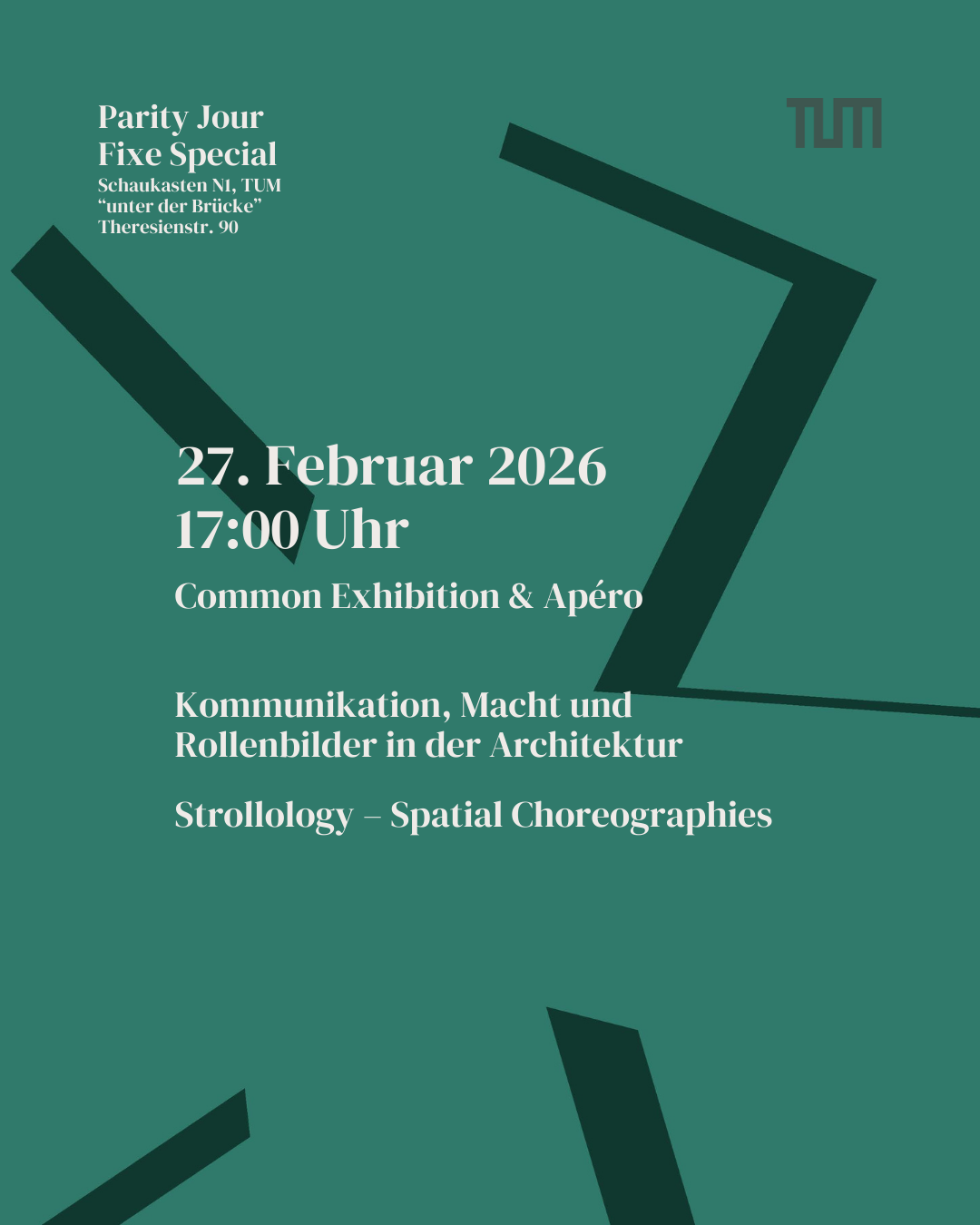
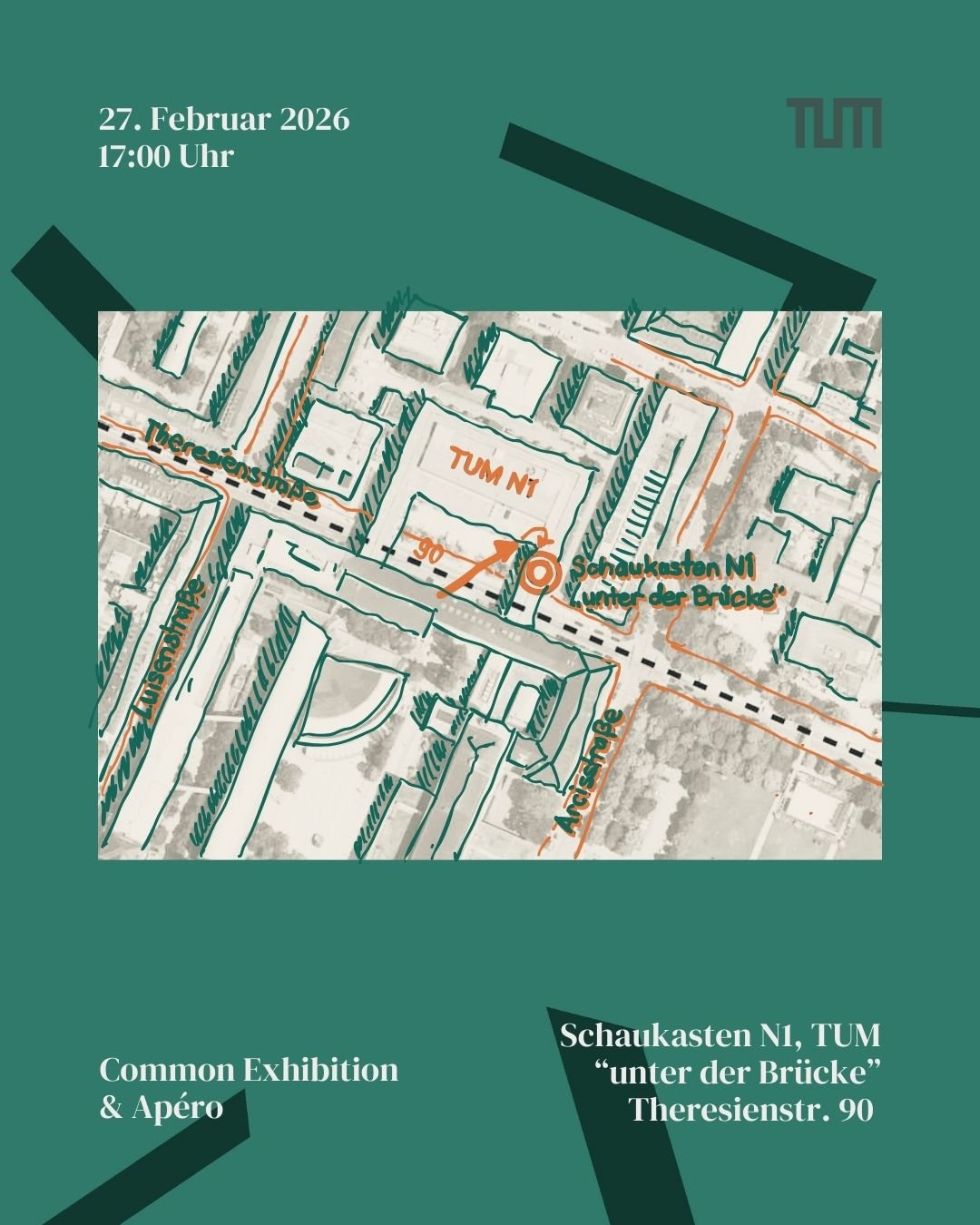
Parity Jour Fixe Special, 27.02.2026, 17:00 Uhr
Common Exhibition & Apéro
Wir stellen die Gender Lehraufträge des WS 25/26 vor.
Zwei Seminare zeigen unterschiedliche Zugänge zu Raum, Architektur und Wahrnehmung.
Die Veranstaltung gibt Einblick in die Arbeiten der Studierenden und lädt dazu ein, über Zugänglichkeit, Diversität und Machtstrukturen in der Architektur(lehre) ins Gespräch zu kommen.
Sandra Cabrales (Lehrbeauftragte)
Henriette Lutz (Lehrbeauftragte)
Sophia Pritscher (Parity Group TUM)
Content
-
-
-
-
How Biases Are Built into Our Perception and the Narratives within Architecture
-
Architecture is created in teams
-
-
-
-
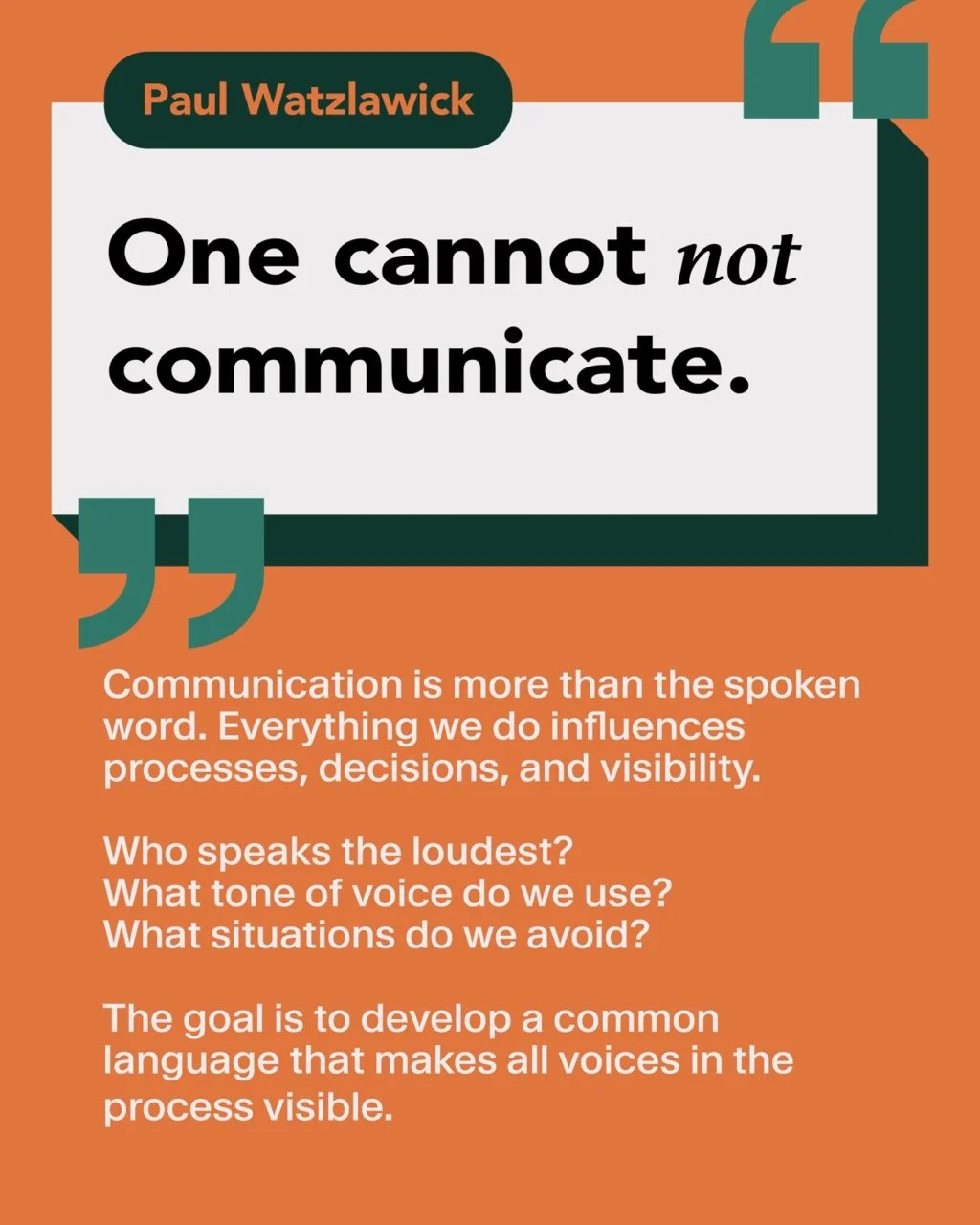
One cannot not communicate

One cannot not communicate.
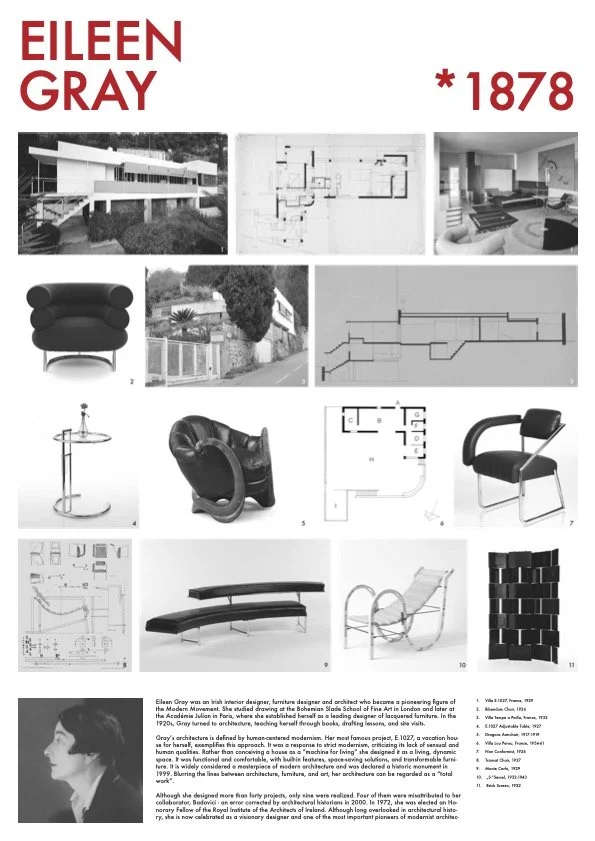
Their ideas shape famous projects, but their names disappear from history, price lists, and curricula. Denise Scott Brown, Eileen Gray, and Lu Wenyu are examples of female pioneers whose work often remains invisible.
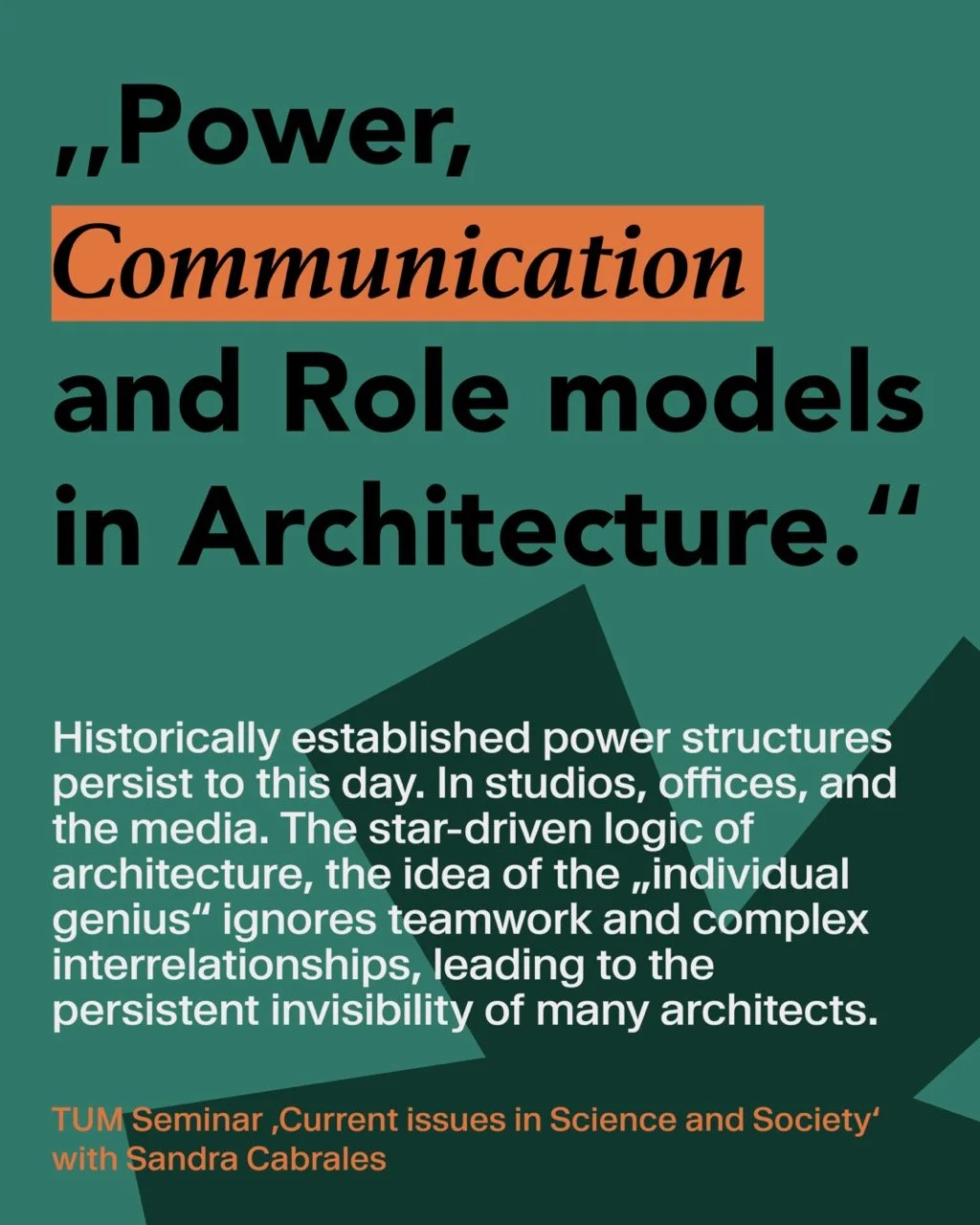
Historically developed power structures continue to have an impact today, in studios, offices, and the media.
The star logic of architecture, the idea of the “individual genius”, ignores teamwork and complex interrelationships and leads to the permanent invisibility of female architects.
As part of a seminar in the Department of Architecture at TUM, we examine how these power structures still operate and how communication, role models, and decision-making processes shape us and our architecture praxis. Who decides which topics are considered important, how are contributions weighted, which voices are heard, and who is left out? These questions inevitably lead to a critical look at our own position in teams and projects.
Communication is more than just the spoken word. “You cannot not communicate,” says Paul Watzlawick, everything we do influences processes, decisions, and visibility. Who speaks loudest in the team, and why? What tone of voice do we use, and in which situations do we withdraw? What words do we use to make ourselves smaller or bigger?
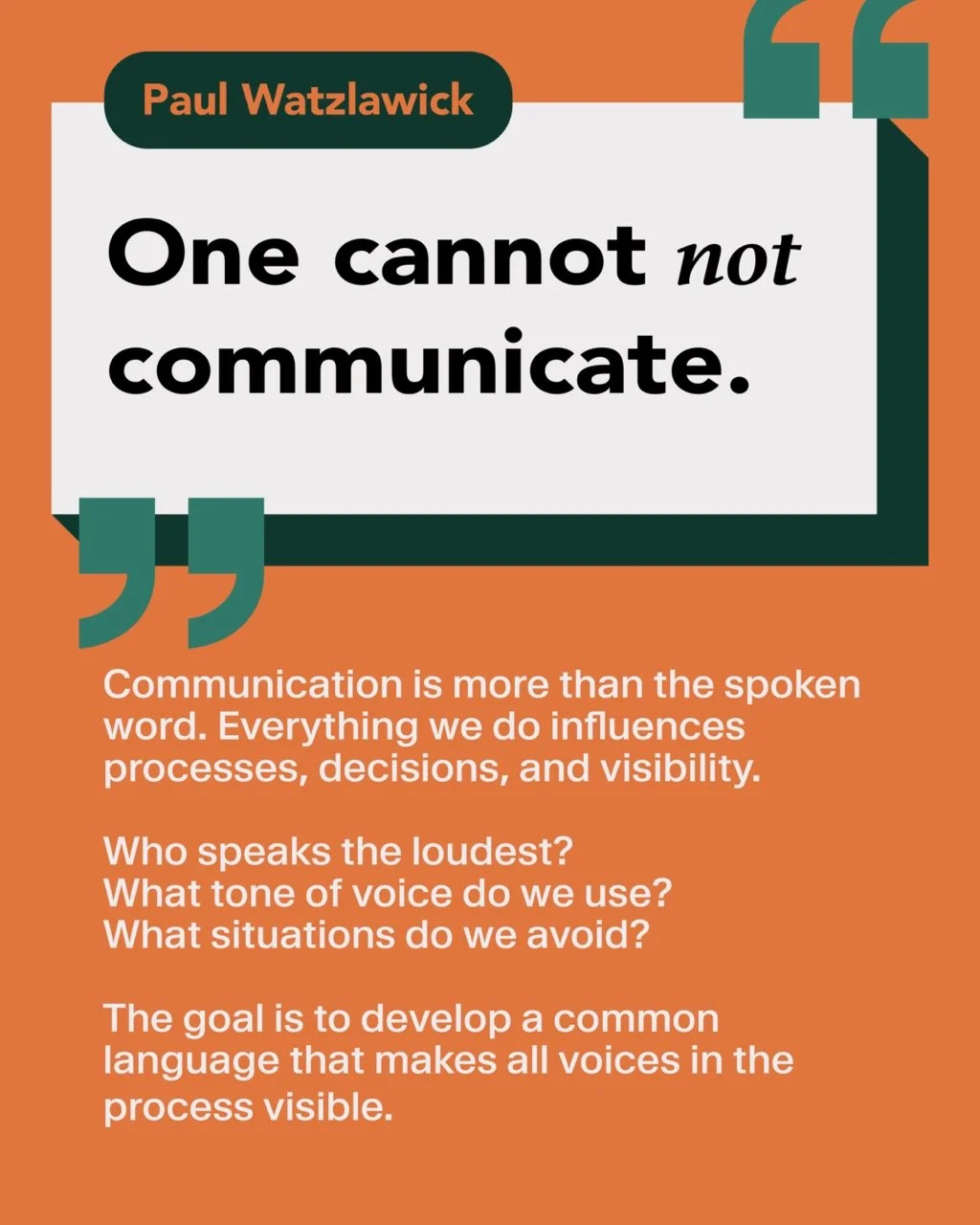

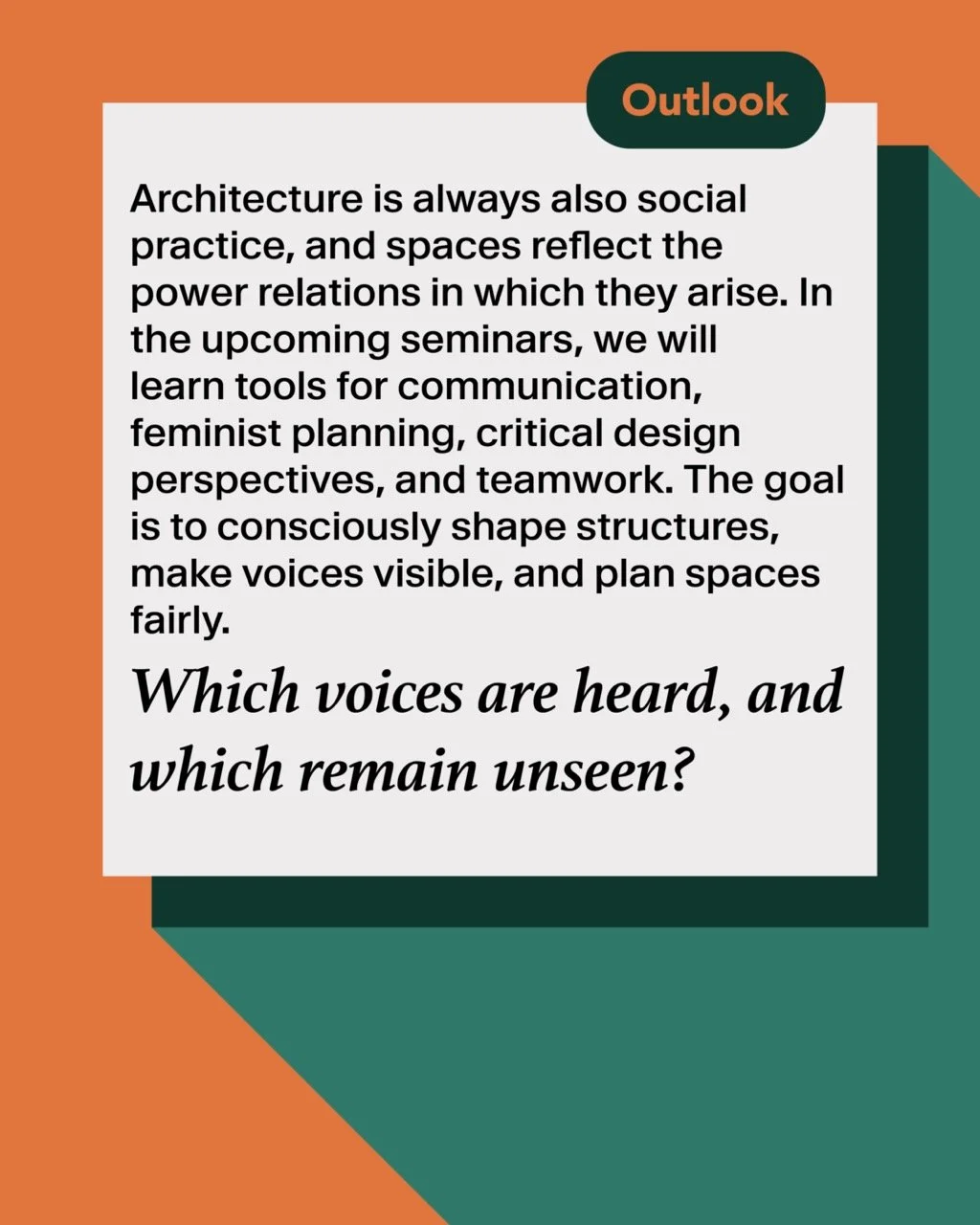
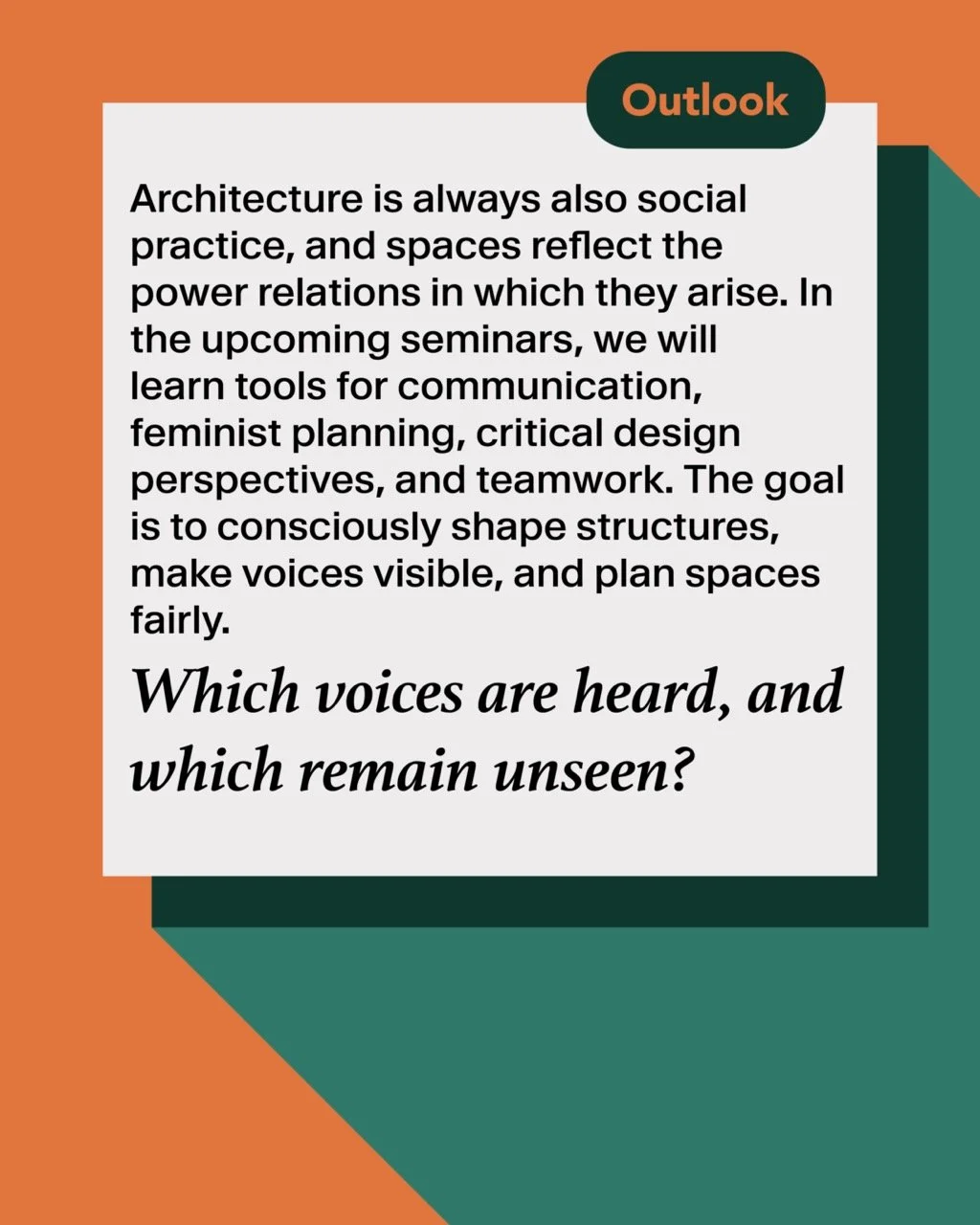
Which voices are heard, and which remain unseen?
The aim is to establish a shared language that ensures all voices are heard and leads to more inclusive decision-making.
Power manifests itself subtly in price lists, decisions, evaluation systems, and project allocations. Who makes decisions, and who is not asked? Which topics are considered important, and which are devalued? Power is often passed on unconsciously, but this is precisely where the opportunity lies: those who recognize power structures can question them and consciously shape them.
We face the challenge of consciously reflecting on power, questioning roles, and shaping communication in a targeted manner. Those who know their own voice, distribute visibility, and recognize power structures contribute to teams working more equally and spaces being planned more inclusively.
Architecture is always also a social practice, and spaces reflect the power relations in which they are created.
In the upcoming seminars, we will learn tools for communication, feminist planning, critical design perspectives, and teamwork. The goal is to consciously design structures, make voices visible, and plan spaces fairly, who speaks, and who remains invisible?
Only through critical questioning, interdisciplinary cooperation, and the conscious involvement of all participants can planning processes be developed that break down old hierarchies and promote equal opportunities and diversity.

How do you listen?
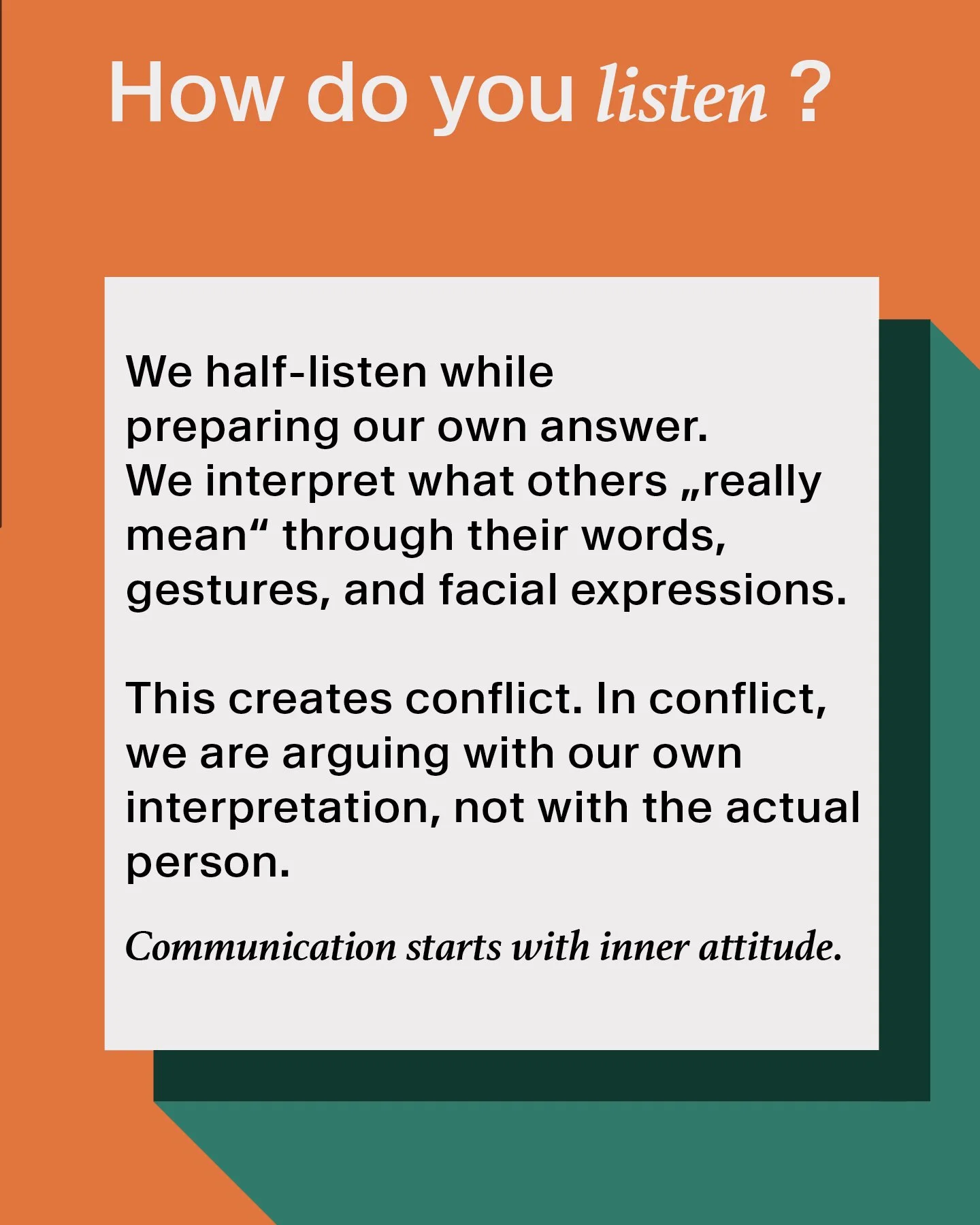
In professional life, there is often a sense or even a pressure to communicate with project partners, employees, supervisors, and colleagues mainly on the content level. Stress, problems, and conflicts, however, usually arise on the relationship level. So it is rarely about the “what,” but rather about the “how.”
Many people listen to respond, not to understand. Speaking means receiving attention, listening means giving attention. It is precisely this shift that is at the root of many misunderstandings.
Under pressure, many people resort to automatic response patterns. Fight. Flight. Freeze.
In such moments, communication quickly becomes harsh, unclear, or hurtful. Responsible work requires awareness of how stress changes one's own behavior and how sensitively the relationship level reacts to it.
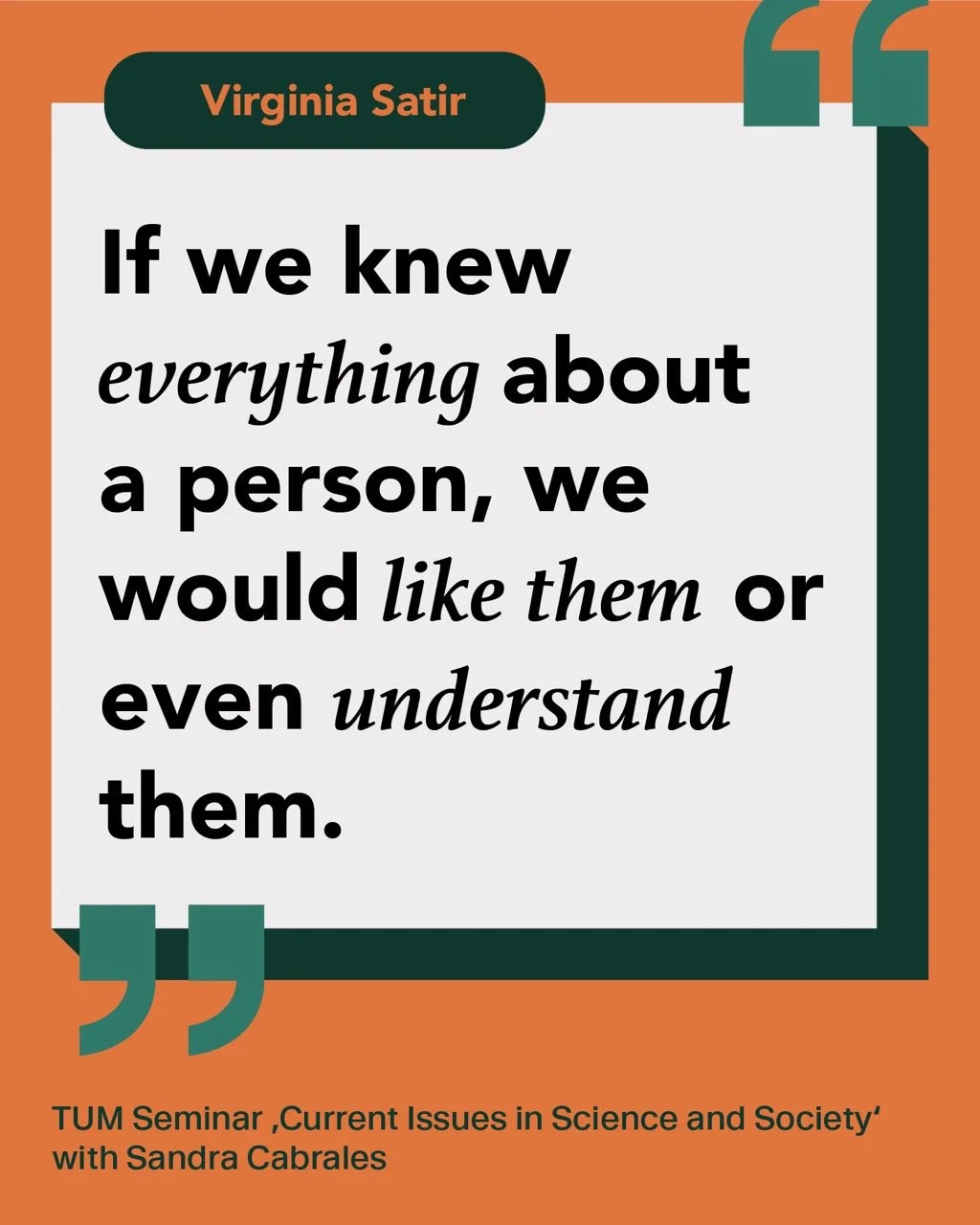
Communication on an equal footing means adopting an OK OK position. Both sides are OK. The person is separated from the problem. Motives and reactions are taken seriously. Virginia Satir's idea is groundbreaking here: if we knew everything about a person, we would like them or at least understand them.
Successful conversations arise from clarity, preparation, and the ability to assess one's own impact. This also includes an awareness of one's own patterns and sensitivities. What challenges us and why. Where do tensions arise? Those who are aware of these dynamics encounter others with more calm and prevent unnecessary escalations.
Another pattern that repeatedly becomes apparent is that people often talk past each other. Details are lost and interpretations take over. Appreciation is demonstrated by listening carefully and perceiving what is said precisely.
Communication at eye level is an active choice. It is becoming increasingly important in an industry that is often characterized by overtime, pressure, and exhausting working conditions. How are architects supposed to design spaces in which people feel comfortable when their own working environments convey the opposite?
Good work is created where people work in healthy, appreciative, and inclusive structures.
This attitude is a prerequisite for successful collaboration and sustainable quality.

Designing Collaboration
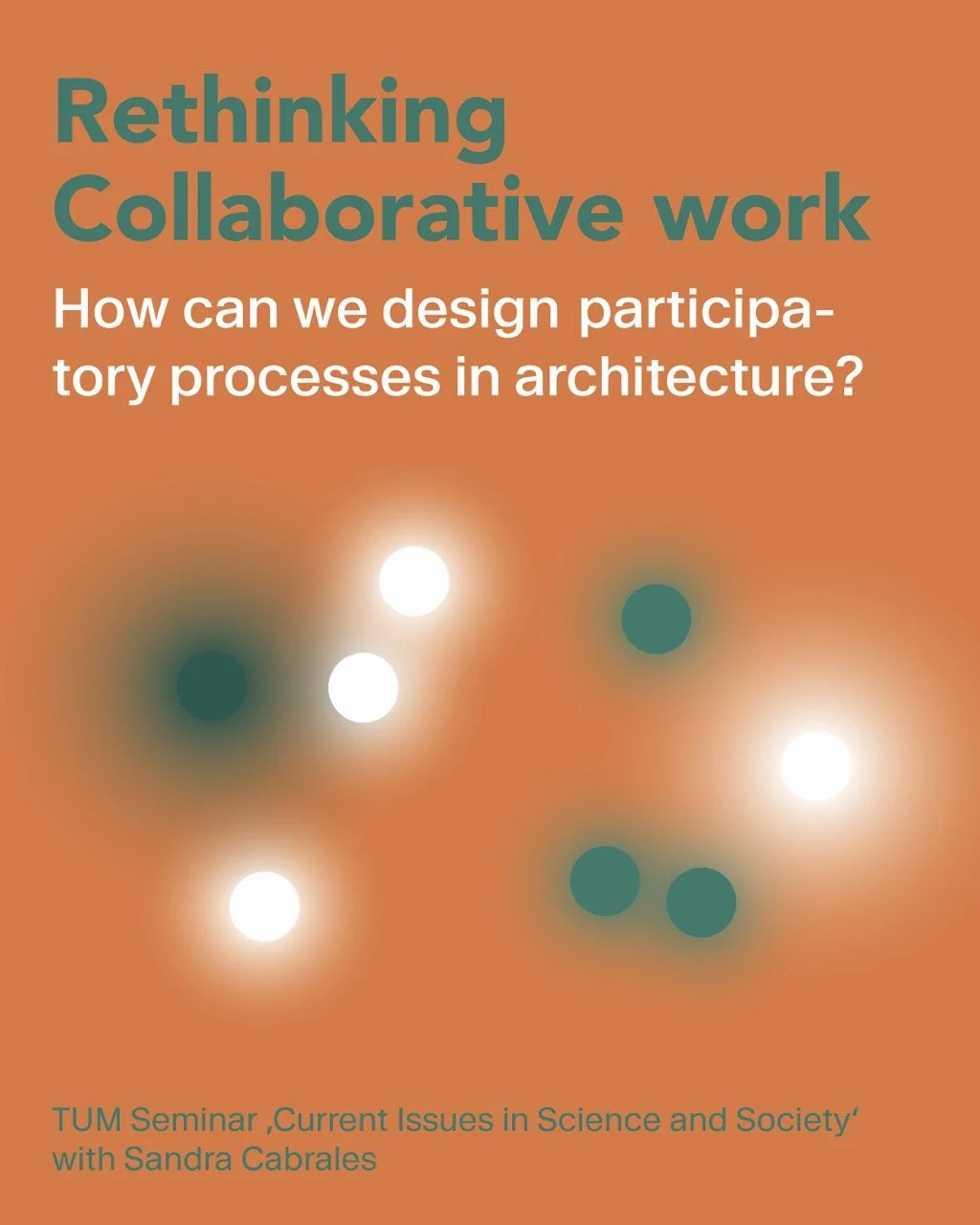
Architecture is created in teams - yet collaboration is rarely designed. In the third session of the seminar “Current Issues in Science and Society”, we explored how collaboration can be consciously shaped.
Group work is more than an organisational step. It determines which voices are heard, which ideas are able to unfold, and how responsibility is distributed. Dominant voices prevail, others withdraw, tasks are silently taken over. Processes remain invisible - and with them the people who sustain them.
To address this, we tested the Town-Hall method, a participatory format where one person stays as host while others rotate between tables. Knowledge circulates, perspectives meet, and responsibility is shared. The method demonstrated that collaboration does not happen by chance - it requires structure, reflection, and attention to roles.
Roles in groups are never neutral. Who moderates, who documents, who oversees the process? Who takes on care or organisational work? Who becomes visible – and who remains in the background? By reflecting on these questions, we became aware of unconscious dynamics and power structures, and learned how consciously assigned roles can strengthen participation and fairness.
Architecture is always a social practice, and group work mirrors power relations that otherwise remain unseen. By designing processes, clarifying responsibilities, and consciously choosing roles, we can strengthen teams, open perspectives, and create more inclusive spaces.
This session was a step toward an approach that critically questions not only what we design, but how we work together. Those who know their own role, take responsibility, and reflection on processes contribute to collaboration that succeeds – and to architecture shaped by many voices.

Architecture is created in teams.
Yet how collaboration is structured often remains unquestioned.
In this seminar session of Communication, Power, and Role Models, students examined how roles shape teamwork and how invisible patterns influence what is valued as work.
The session introduced historical organizational structures. Each structure reflects the power relations and values of its time, which shows that these structures are inherently political.
With developments in the 1920s and the automobile industry, Taylorism fragmented work into small, repeatable steps to enable mass production. Creativity was neither required nor desired. This approach is rooted in Theory X, a view of human nature articulated by Douglas McGregor that assumes people are fundamentally unmotivated and require external incentives such as money, control, or punishment to perform.
Theory Y offers a contrasting view: people are engaged, self-motivated, and capable of self-direction when given autonomy and responsibility. These models are not merely abstract theories, they shape leadership styles, team roles, and the distribution of power within organizations.
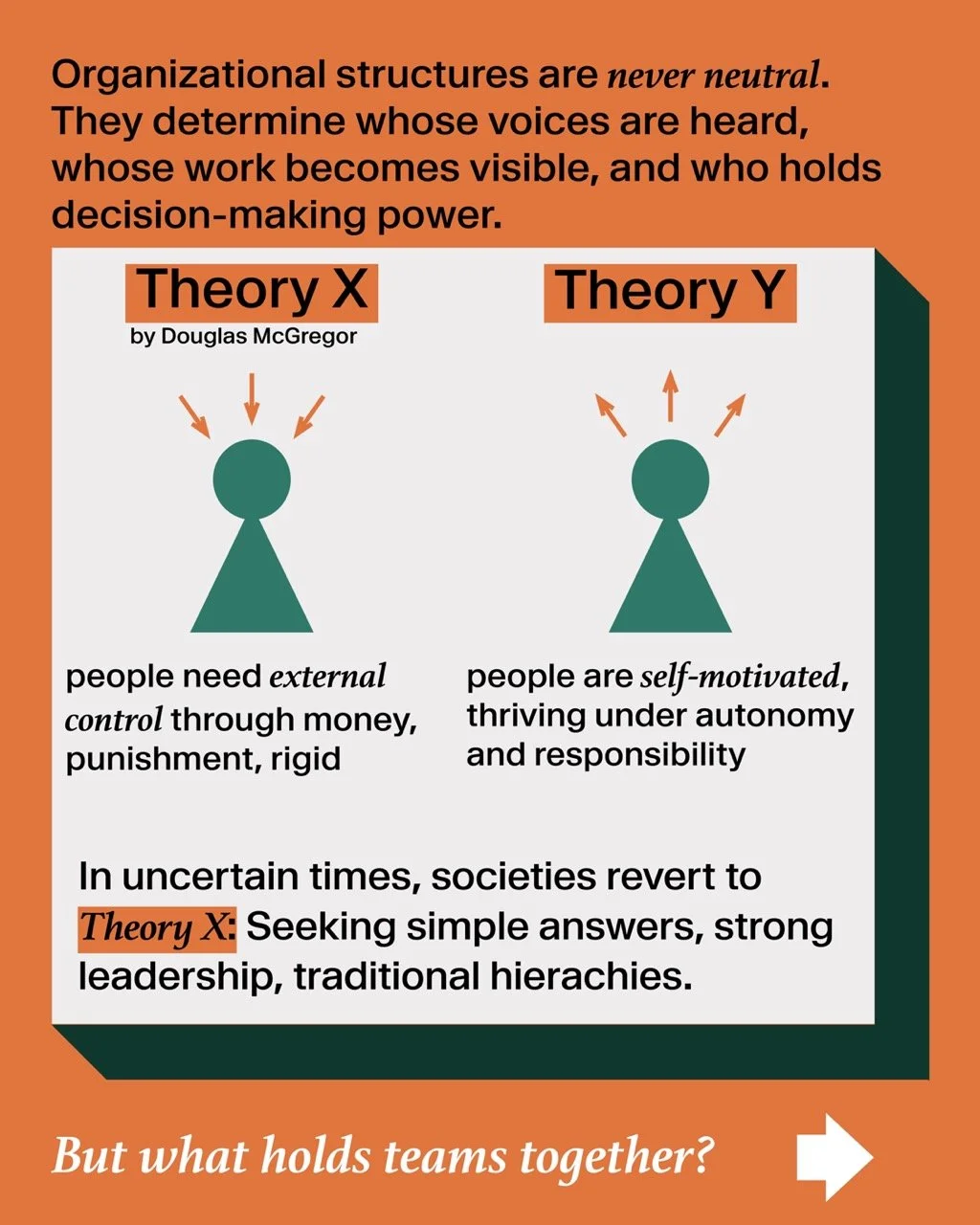
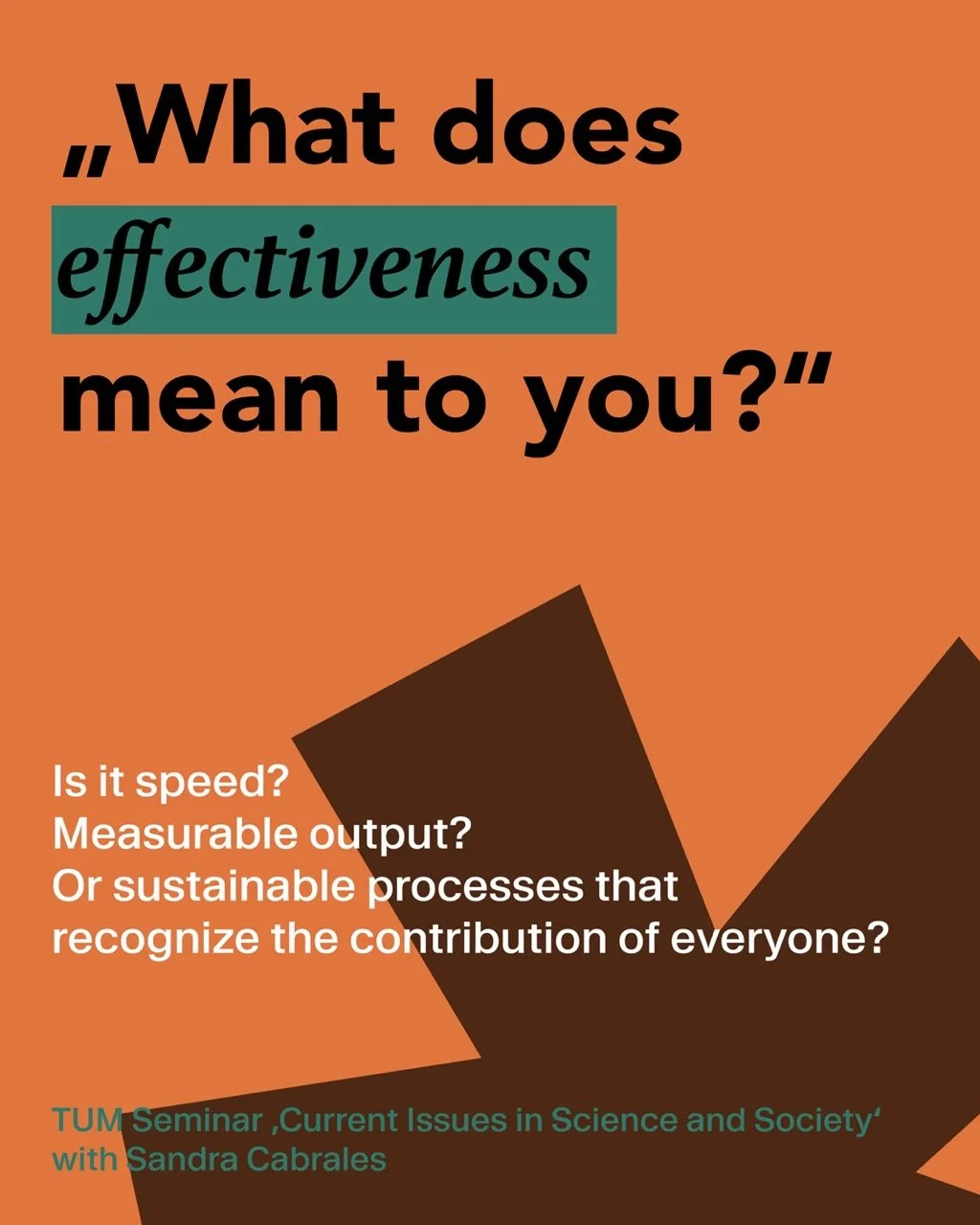
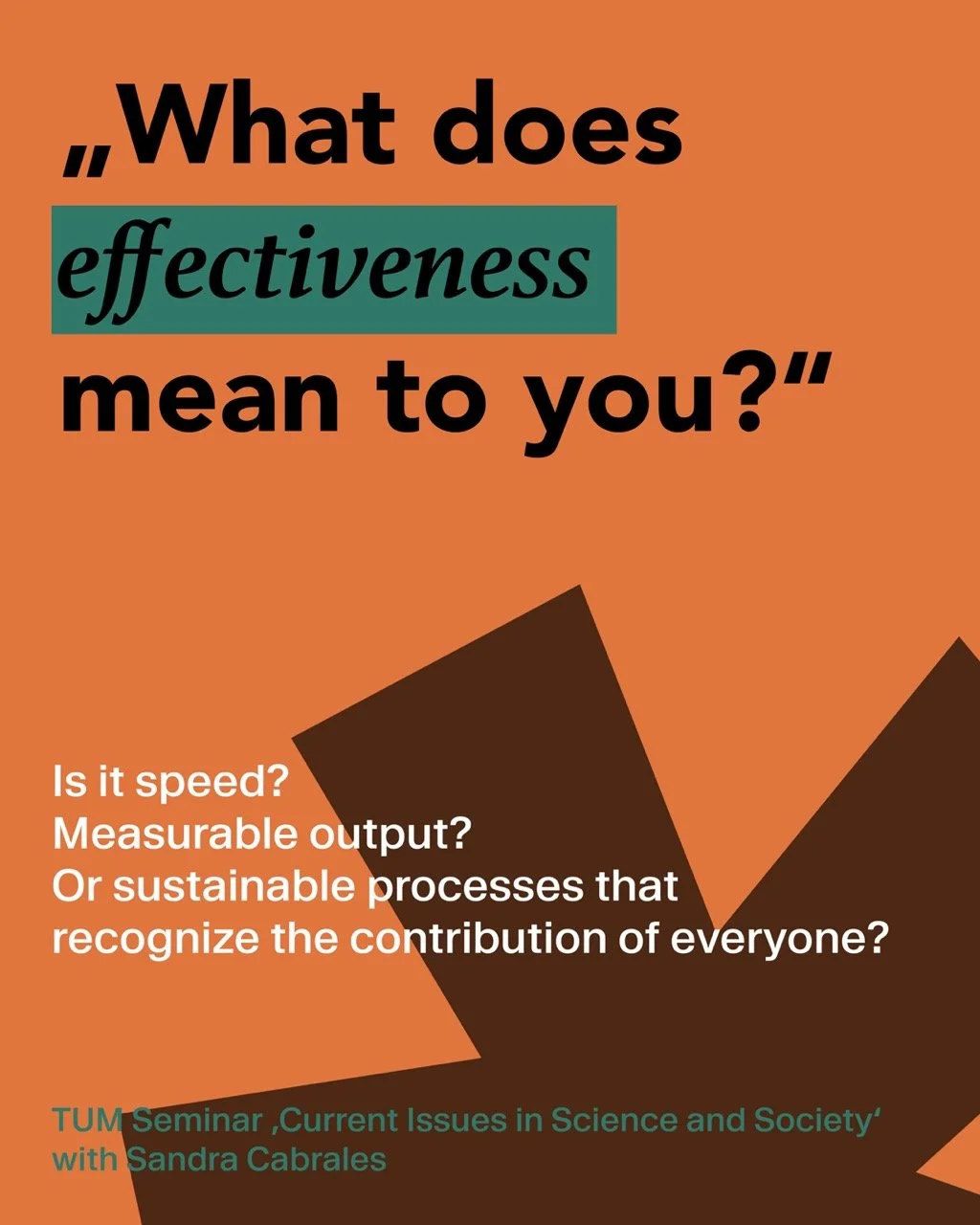
The concept of effectiveness is defined by context and reflects underlying values about what work is, who does it, and whose contributions count. When teams prioritize speed and measurable output, other forms of labor become invisible. Care work, relationship maintenance, and the emotional labor that holds teams together are excluded from definitions of productivity. They are treated as secondary, even though they are foundational.
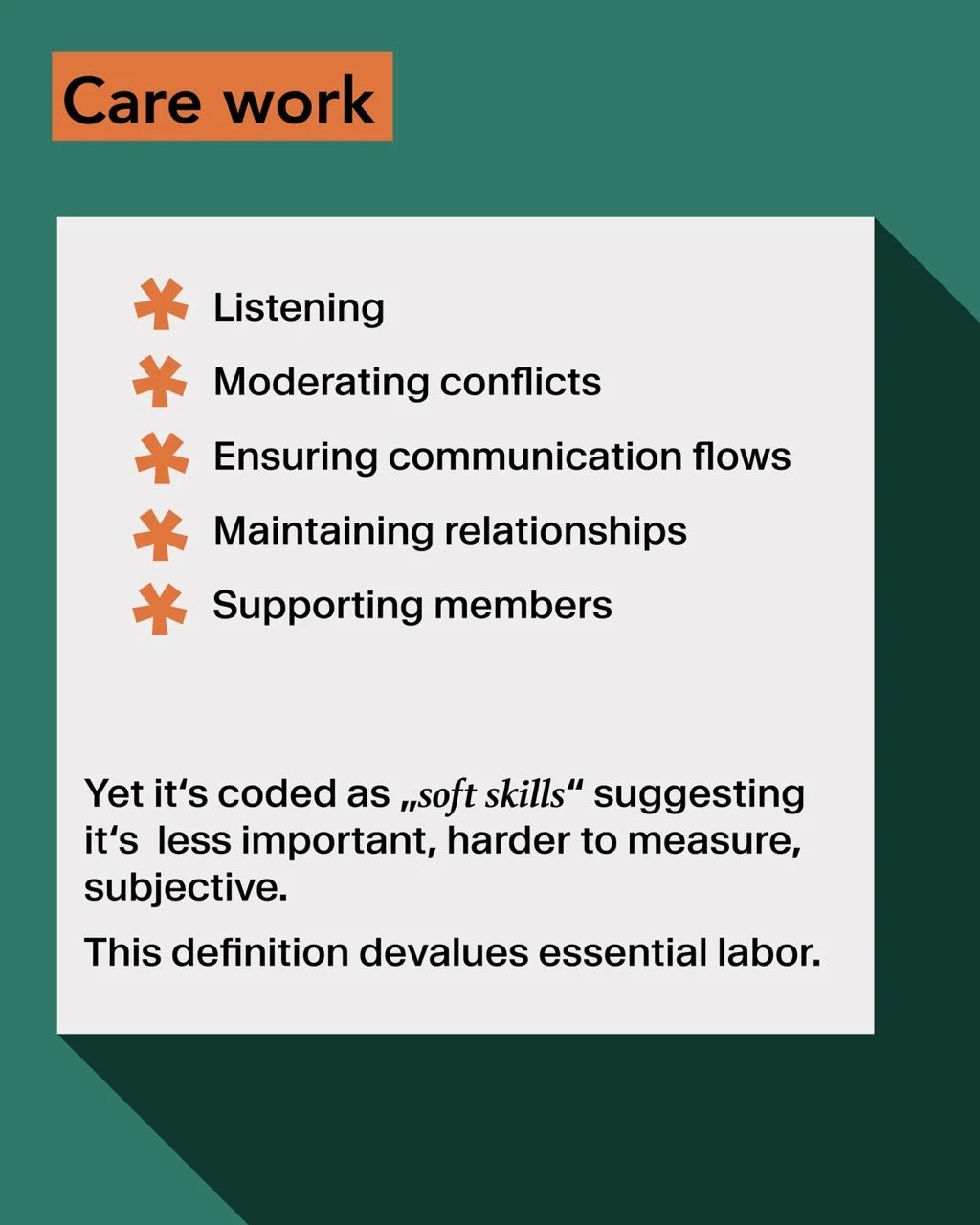
Care work in teams includes listening, moderating conflicts, maintaining relationships, and supporting members. This labor is essential, yet it is rarely named in job descriptions or rewarded in evaluations. It is coded as "soft skills" or assumed to be natural rather than learned. The term "soft skills" itself is discriminatory. It suggests this work is less important, harder to measure, and subjective compared to "hard skills." This distinction reproduces a hierarchy that devalues care.
Research shows that women carry a disproportionate share of care work, both at home and in professional settings. Women spend more time on administrative tasks, emotional labor, and non-promotable work. These are tasks necessary for teams to function but rarely recognized. This creates what scholars call a "pink tax on time." Women have less objective time and experience their time as more fragmented and stressful. Even when men perform the same care tasks, their actions are often reframed as leadership.
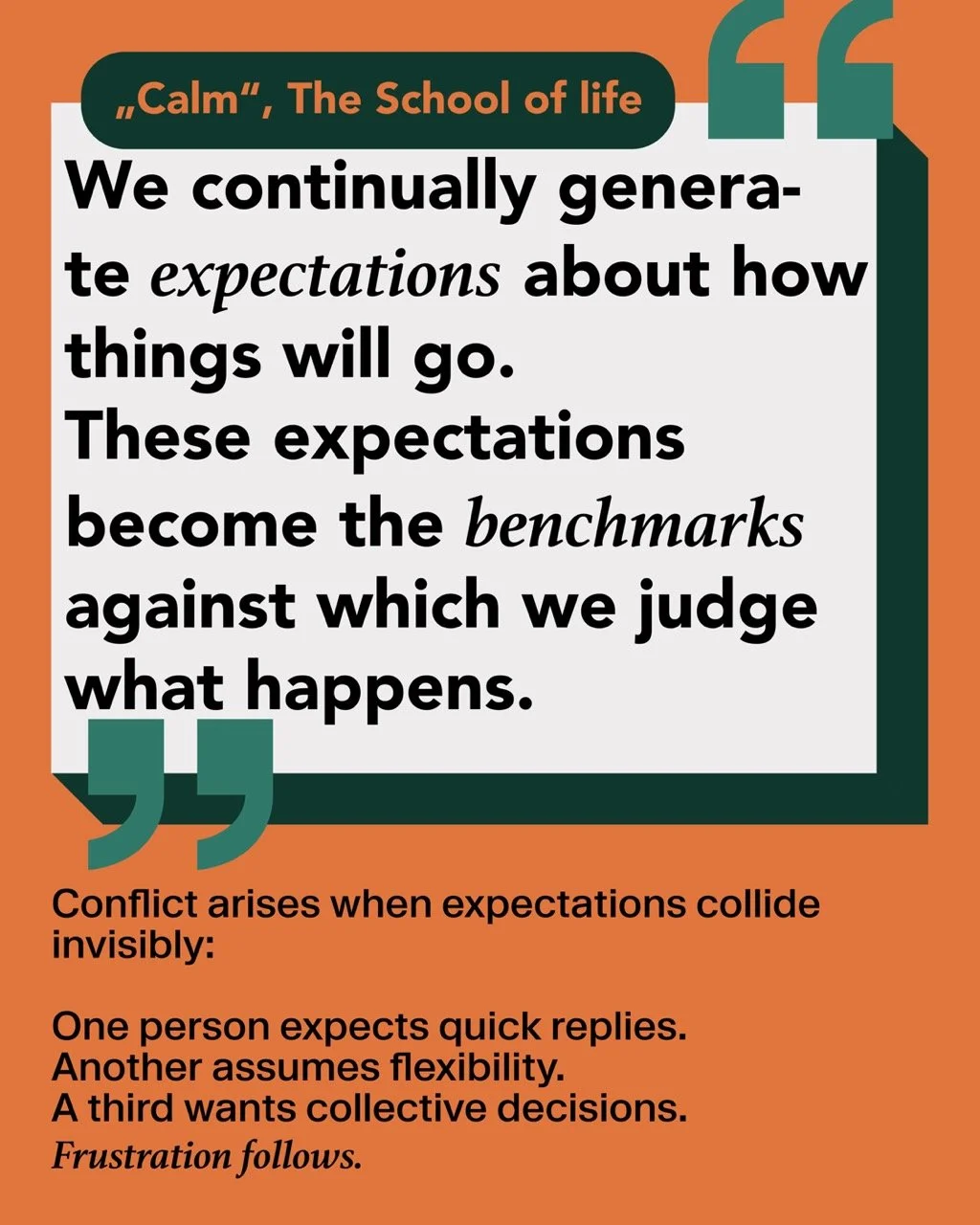
As The School of Life writes in "Calm": "A fundamental feature of the way our minds work is that we continually generate expectations about how things will go. Almost without noticing our tendencies, we draw up scenarios of how the future should unfold. These expectations are in no way innocent; they become the benchmarks against which we judge what actually happens."
Conflict often arises not because things go wrong, but because they go wrong in ways that were not expected. People carry unspoken assumptions about how collaboration should function. These expectations remain invisible until they collide and frustration follows.
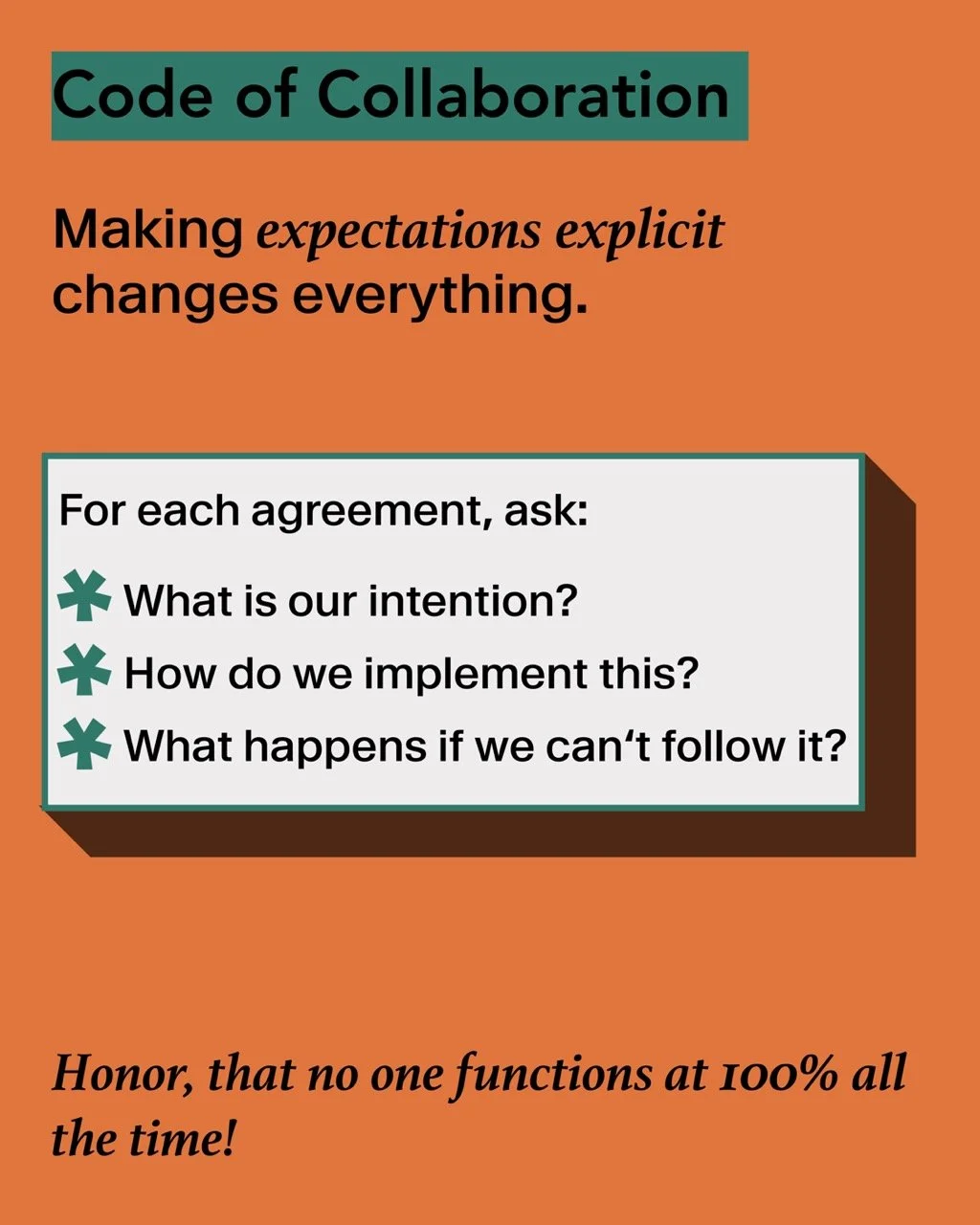
Creating a code of collaboration makes expectations explicit, provides orientation and reduces friction. For each guideline, groups answered: What is our intention? How do we implement this? What happens if it can't be followed? These codes honor that people have different rhythms and capacities, that no one functions at 100% all the time. The process required teams to name what mattered to them and why.
The goal was not to impose a model rather to make teamwork a conscious practice because roles, care, and collaboration are not fixed structures, they can be actively designed and transformed.
While there has been gradual movement toward Theory Y in recent decades, uncertain global conditions such as wars, economic instability, and rapid change push societies back toward conservatism. In times of insecurity, people seek stability, simple answers, and strong leadership. This creates the foundation for Theory X thinking, political shifts to the right, and the reversion to traditional role patterns. The architecture profession, with its long hours, hierarchical structures, and emphasis on individual genius, often reflects Theory X assumptions even when it claims to value collaboration.
Students explored roles as the basic unit for organizing work. A role has a name, a purpose, and responsibilities that others can expect. Role holders have authority to fulfill that purpose.
In group reflection, students examined which roles they had consciously or unconsciously taken on in their projects. They shared what they needed to fulfill their roles well and what others could expect from them. The exercise revealed overlaps, gaps, and roles that remained unclear.
The question "What does effectiveness mean?" reveals these hidden values. Is effectiveness about reaching goals quickly, or is it about creating sustainable, inclusive processes?
As Professor Lindsay Howe writes in "The Secret Tax on Women's Time": "The meaning of work needs to be redefined from a limited set of glorified professional activities to incorporate the important unpaid labor women, and to a lesser extent men, conduct both at work and at home. Counting these often-invisible acts formally as work, having employees track it, and managers reward it could represent a first step toward rectifying unequal time demands at work."
Recognizing care work means redefining what counts as work. It means naming these activities, building time for them into schedules, and valuing them equally alongside other contributions. It also means questioning who is expected to do this work and why.
The session closed with groups developing their own codes of collaboration. Rules designed not as restrictions but as shared agreements. This work addressed a fundamental challenge in teamwork: the gap between expectations and reality.
Students
Brit Austermühl, Marie Gebel,
Charlotte Meinecke, Louisa Schütz
date
23. February 2026
How Biases Are Built into Our Perception and the Narratives within Architecture
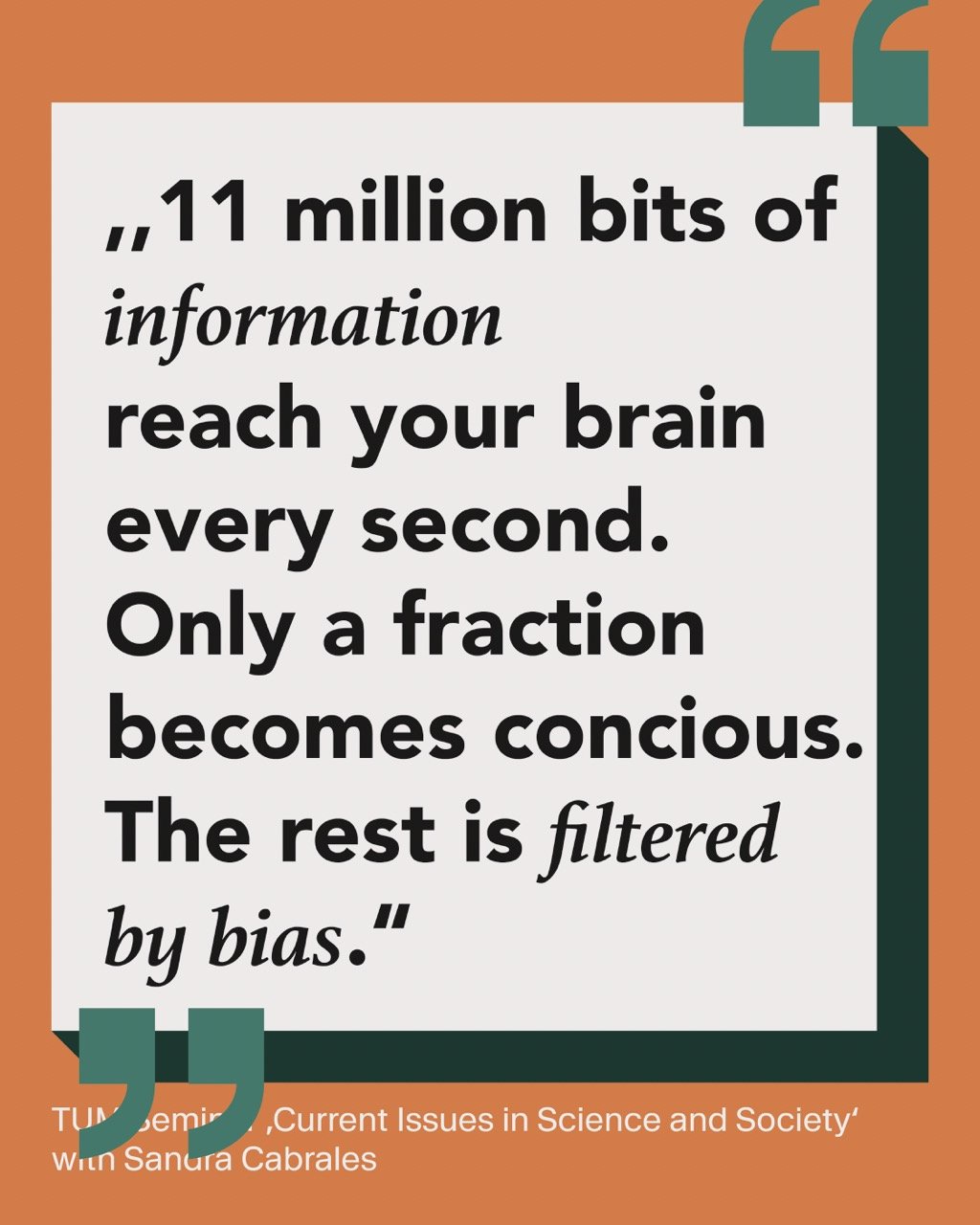
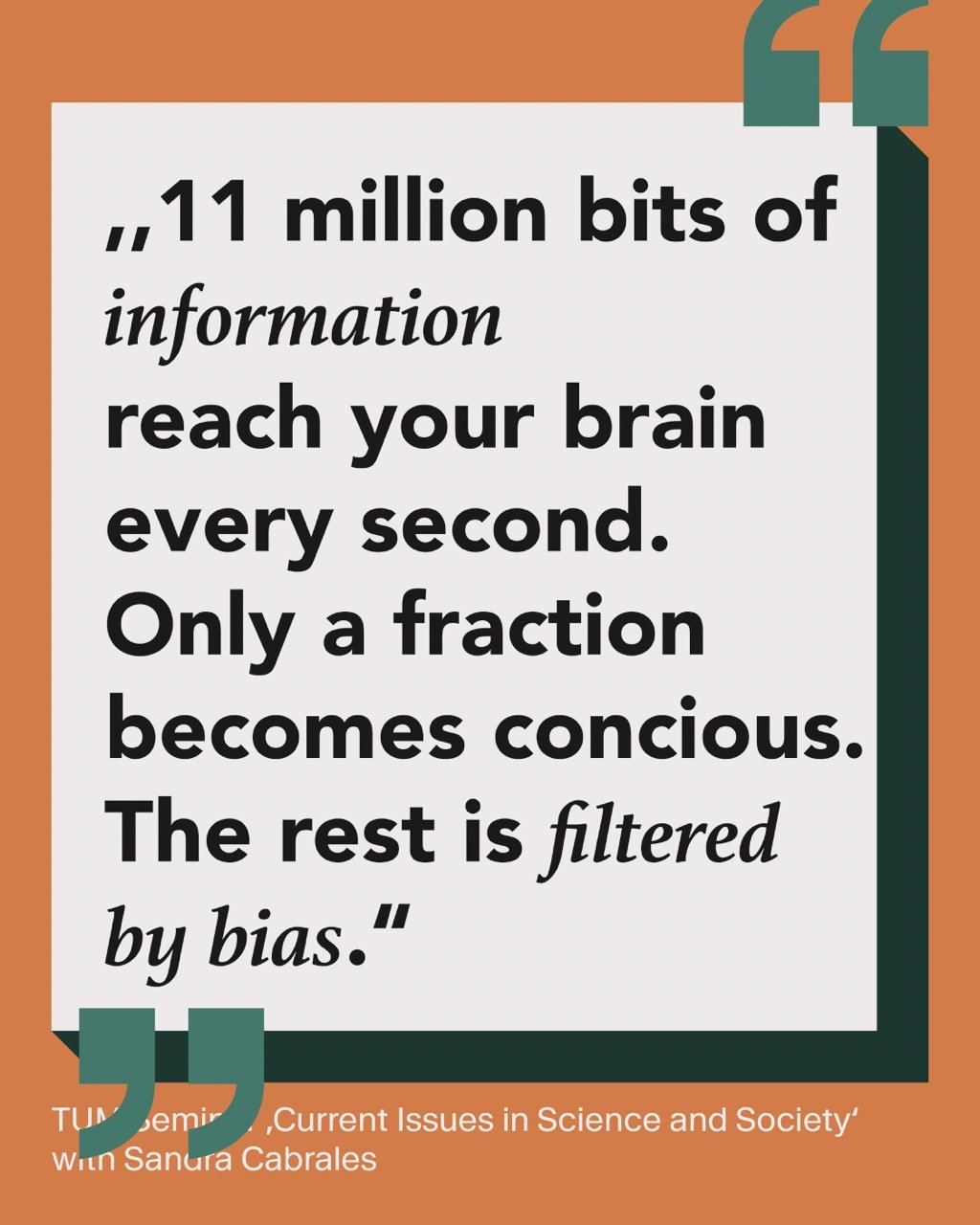
Every second, eleven million bits of information reach the human brain. Only a fraction becomes conscious. The rest is filtered, sorted, and categorized through patterns developed over a lifetime. These patterns enable quick decisions but also create distortions. They are the foundation of what psychologists call unconscious bias, automatic and unaware evaluations of situations, people, and ideas.
Unconscious bias is not a personal failing. It is a feature of human cognition, rooted in evolutionary survival mechanisms. In early human history, the ability to quickly distinguish between familiar and unfamiliar, safe and threatening, was essential. The brain developed shortcuts to process vast amounts of information rapidly. These shortcuts persist today, even though the context has fundamentally changed.
The term "unconscious bias" emerged from psychological research in the 1970s. It describes evaluations shaped by background, experience, professional socialization, and cultural context. Bias enables efficient decision-making but can distort perception, block opportunities, and strain collaboration. In architecture, where decisions shape the built environment for diverse populations, the consequences of bias extend far beyond individual interactions.
The biological basis of bias lies in the limbic system, the part of the brain responsible for processing emotions and threats.
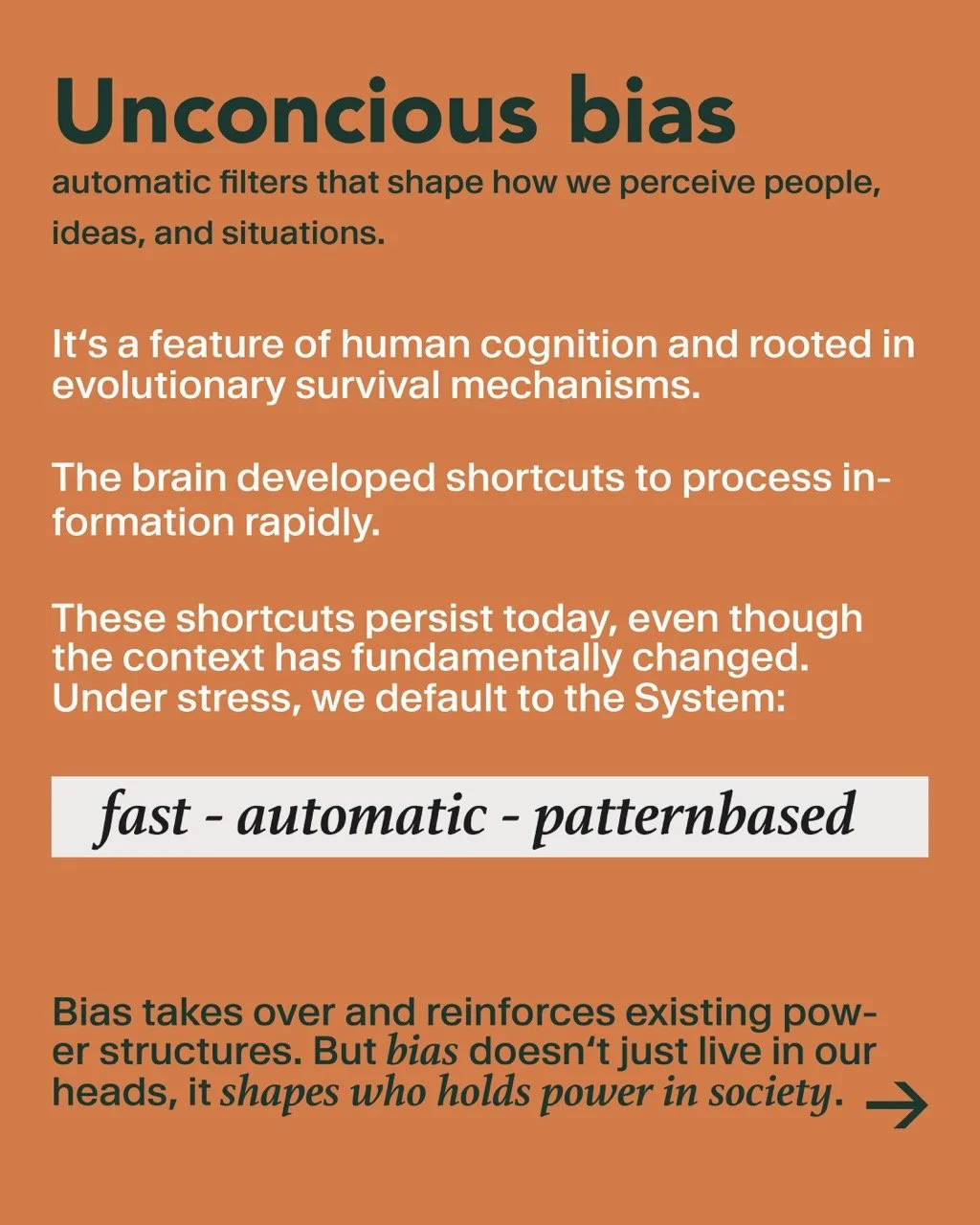
Under stress, the brain relies on System 1 thinking, fast, intuitive, and automatic. System 2 thinking, which is slow, deliberate, and analytical, requires effort and cognitive resources. When under pressure, System 1 dominates. Decisions are made quickly, based on pattern recognition rather than careful analysis. This can reinforce existing biases rather than challenge them.
Unconscious bias manifests in multiple forms, each with distinct effects on collaboration and decision-making:
We can detect twelve (there are more) types:
-
evaluates people differently based on gender. Women are often perceived as less competent in leadership or technical fields, regardless of actual performance.
-
("mini-me" effect) describes the tendency to prefer people similar in education, interests, or lifestyle. This creates homogeneous teams and limits diversity of perspective.
-
involves unconscious assumptions linked to skin color or origin. It influences hiring and collaboration, disadvantages people with equal or superior qualifications.
-
attributes abilities based on age rather than individual competence. Both younger and older people face stereotypical assumptions.
-
views mothers as less committed or ambitious professionally, reducing career opportunities without evidence.
-
describes aligning with the majority opinion even when holding a different view. The desire for harmony silences innovative ideas.
-
distorts how competence is attributed. Women and marginalized people must prove more to be seen as equally capable.
-
overvalues certain professions while undervaluing others. In architecture, this often means undervaluing engineers, planners, or craftspeople.
-
selects information that supports existing beliefs. Contradicting evidence is ignored, blocking learning.
-
prefers familiar conditions even when alternatives are objectively better. Comfort is valued over change, limiting innovation.
-
describes how one striking trait dominates overall perception. Other qualities are overlooked.
-
captures the strong impact of first impressions. Initial information shapes perception even when later evidence contradicts it.
The architecture profession amplifies certain biases through its own narratives. From the first semesters onward, students are taught that architects are something special. Karin Hartmann describes in "Black Turtleneck, Round Glasses" how architectural education for decades aimed at forming an architect personality with a strong ego. The profession is framed as a calling. Many devote themselves entirely to it and romanticize its meaning.
This narrative elevates the profession but narrows the view on other disciplines and the diversity of society. It reinforces the "star logic" of architecture, the idea of the individual genius, which obscures teamwork and complex collaborative processes. It creates disciplinary bias that devalues contributions from engineers, landscape architects, social scientists, and communities.
Yet architecture designs spaces for people with widely different backgrounds, needs, and realities. Every decision shapes building culture and how people live together. The question "Who is the built environment for?" requires confronting bias directly. Whose needs are centered? Whose experiences are considered? Whose voices shape decisions?
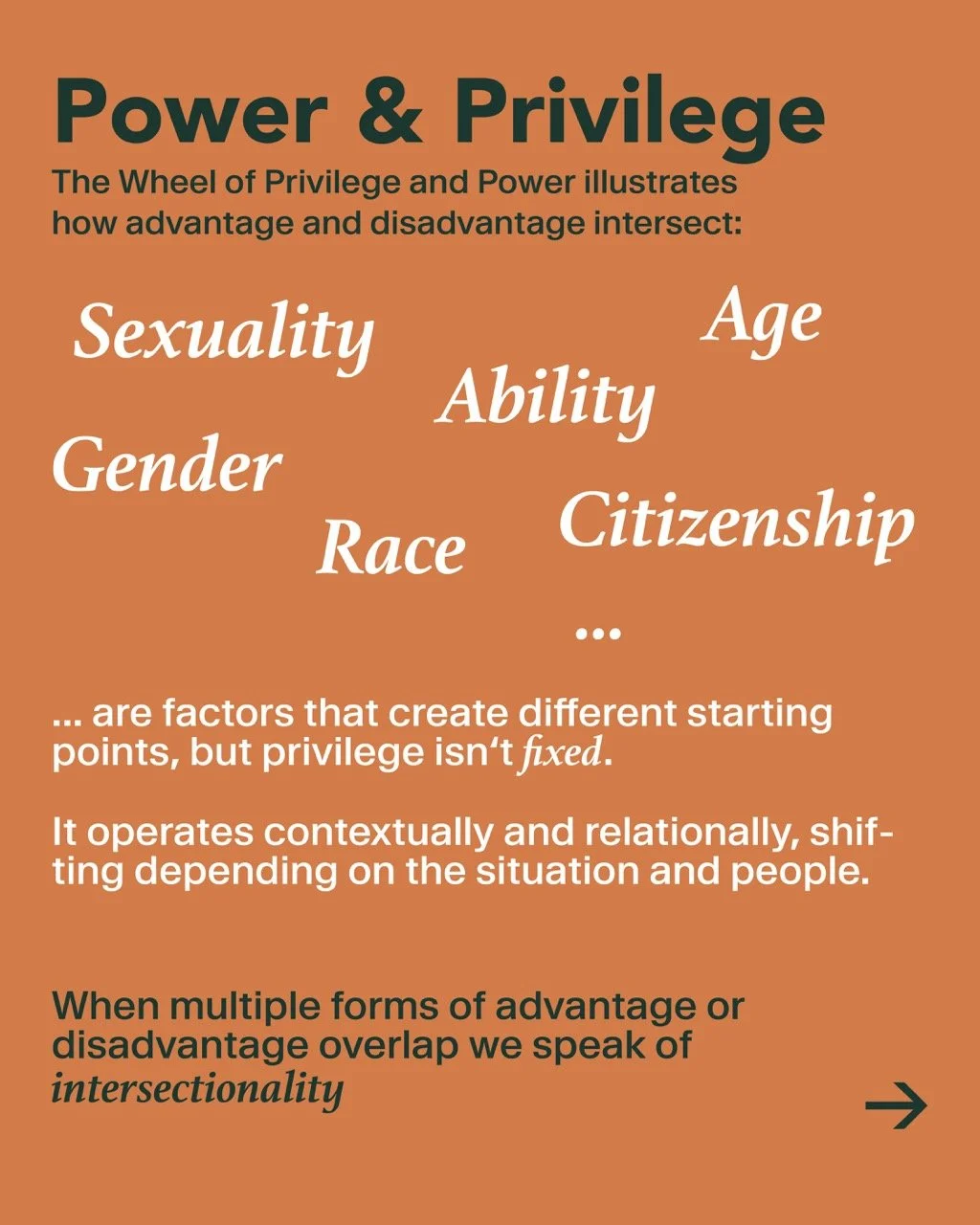
Understanding bias requires examining privilege. The Wheel of Privilege and Power illustrates how multiple forms of advantage and disadvantage intersect. People hold different positions depending on factors such as gender, race, class, ability, sexuality, age, and citizenship status. These positions are not fixed, privilege operates contextually and relationally.
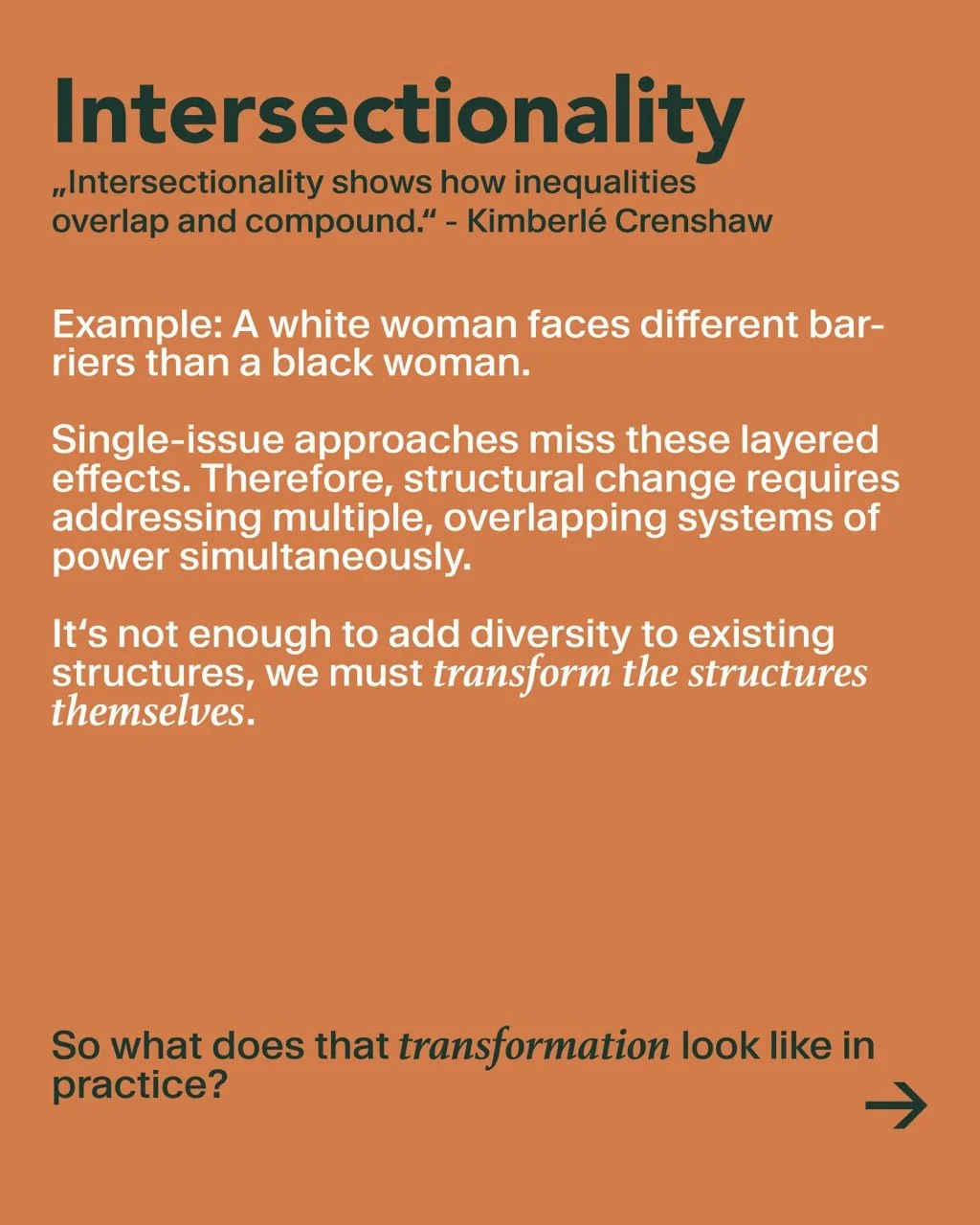
Intersectionality, a framework developed by Kimberlé Crenshaw, shows how various forms of inequality overlap and compound. A person's experience cannot be understood by examining single categories in isolation. A white woman faces different barriers than a Black woman. A disabled person of color experiences discrimination differently than a white disabled person. Single-issue approaches miss these compounded effects.
In professional settings, intersectionality shapes who is pushed into which roles, whose expertise is recognized, and whose contributions are valued. It influences hiring, promotion, project assignments, and whose ideas are taken seriously in meetings. Recognizing intersectionality means understanding that structural change requires addressing multiple, overlapping systems of power.
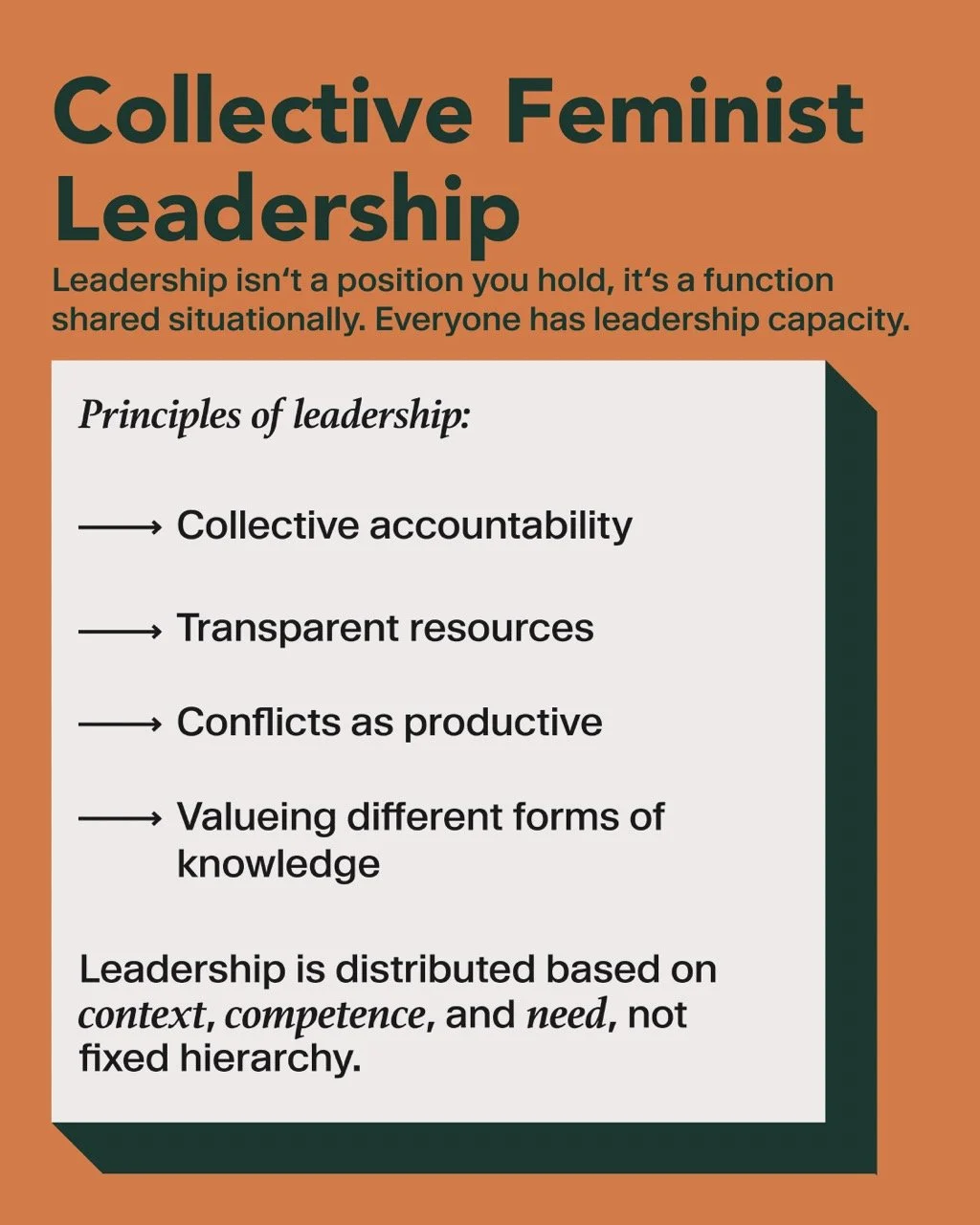
Addressing bias requires more than individual awareness. It requires structural transformation. Collective feminist leadership offers an alternative to traditional hierarchical models. It redefines leadership not as a position someone holds but as a function shared situationally. Everyone has leadership capacity in their areas and perspectives.
This approach challenges mainstream leadership models rooted in individualism, competition, hierarchy, and domination. It rejects the idea that feminist leadership simply means more women in top positions or charismatic "inspirational" leaders. Instead, it positions leadership as a collective, transformative, co-creative process.
Principles include collective accountability rather than individual responsibility, transparent resource distribution, treating conflicts as productive, viewing mistakes as collective learning opportunities, and building in time for relationship work. Leadership is distributed based on context, competence, and need rather than fixed hierarchy.
bell hooks' concept of engaged pedagogy complements this approach. It views teams as learning communities where everyone is a knowledge holder. It recognizes whole persons, not just "workforce." It values different forms of knowledge, experiential, embodied, emotional, not only academic or technical. It acknowledges that confronting privilege and naming discrimination involves pain, and that pain is part of growth.
Addressing unconscious bias is about developing awareness, creating space between stimulus and response.
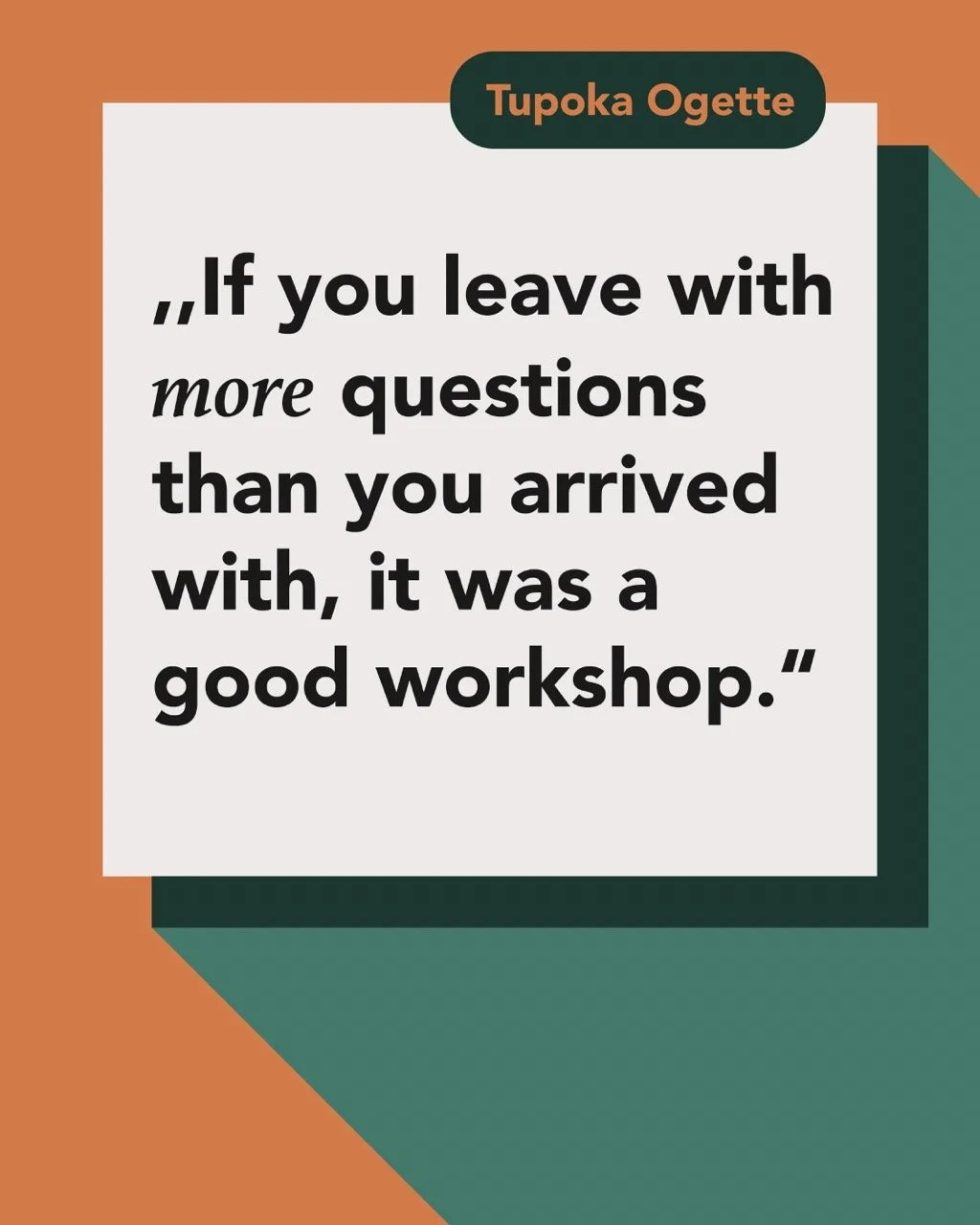
As Tupoka Ogette, an author and anti-racism educator, often says: "If you leave with more questions than you arrived with, it was a good workshop." The work of addressing bias is ongoing. It requires self-reflection, willingness to be uncomfortable, and commitment to changing systems, not just individuals.
Spaces reflect the biases of those who create them. If the goal is inclusive, equitable, human-centered architecture, that work begins with the people and processes that shape it.
CRITIQUE OF THE PRITZKER PRIZE
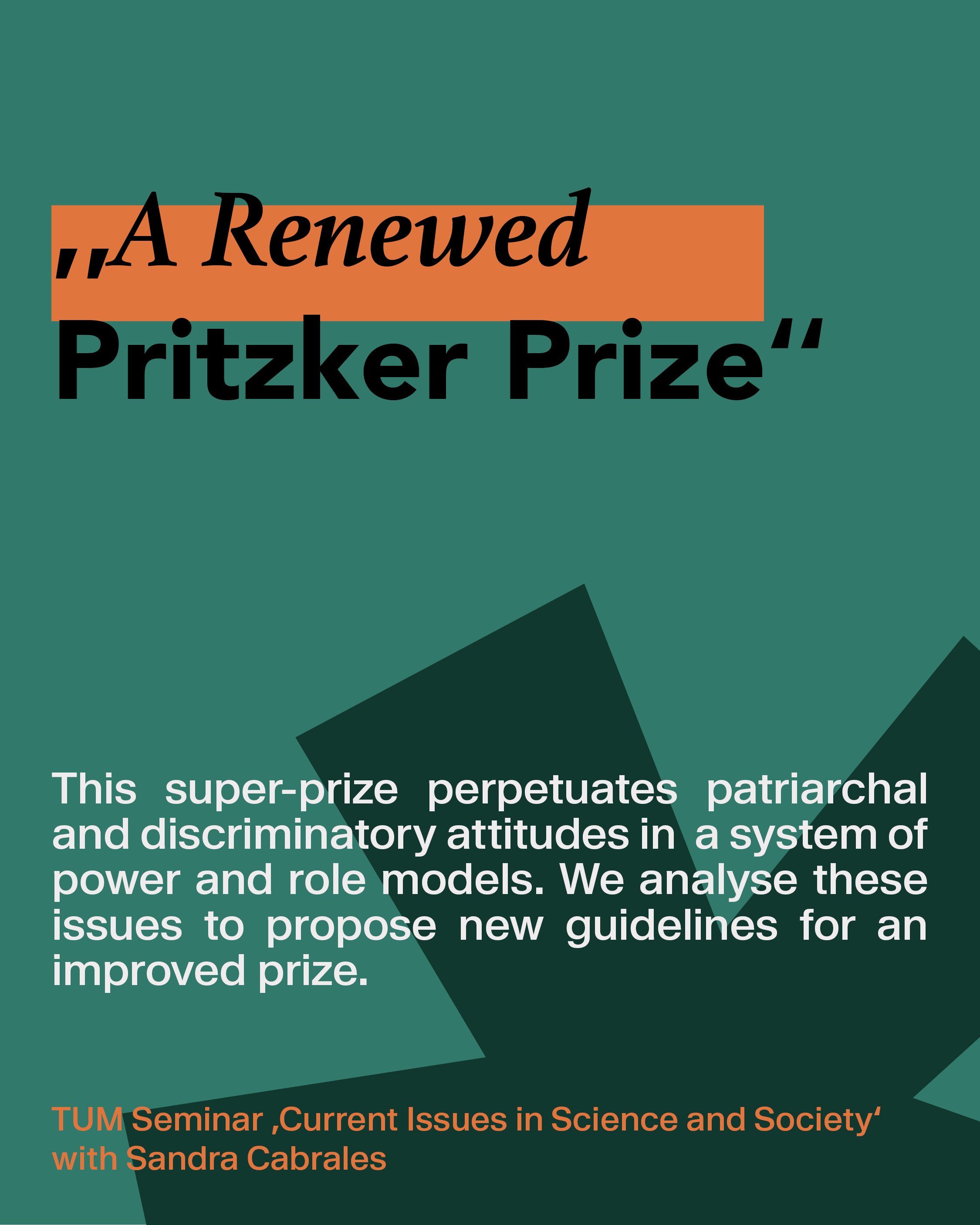
In a perspective of making visible the issues at stake in the Pritzker prize, we decided to collect data and analyse the prize in its actual state to subsequently propose new guidelines for an improved prize.
We wanted to tackle this topic because we understood - at the beginning of the seminar - how this prize embodied the structural problems faced by the world of architecture. With specific anecdotes, we realised that this award perpetuated patriarchal and discriminatory attitudes systems of power and role models.
Students
Alba Ramos, Vidal Res & Felix Mascotto
date
23. February 2026
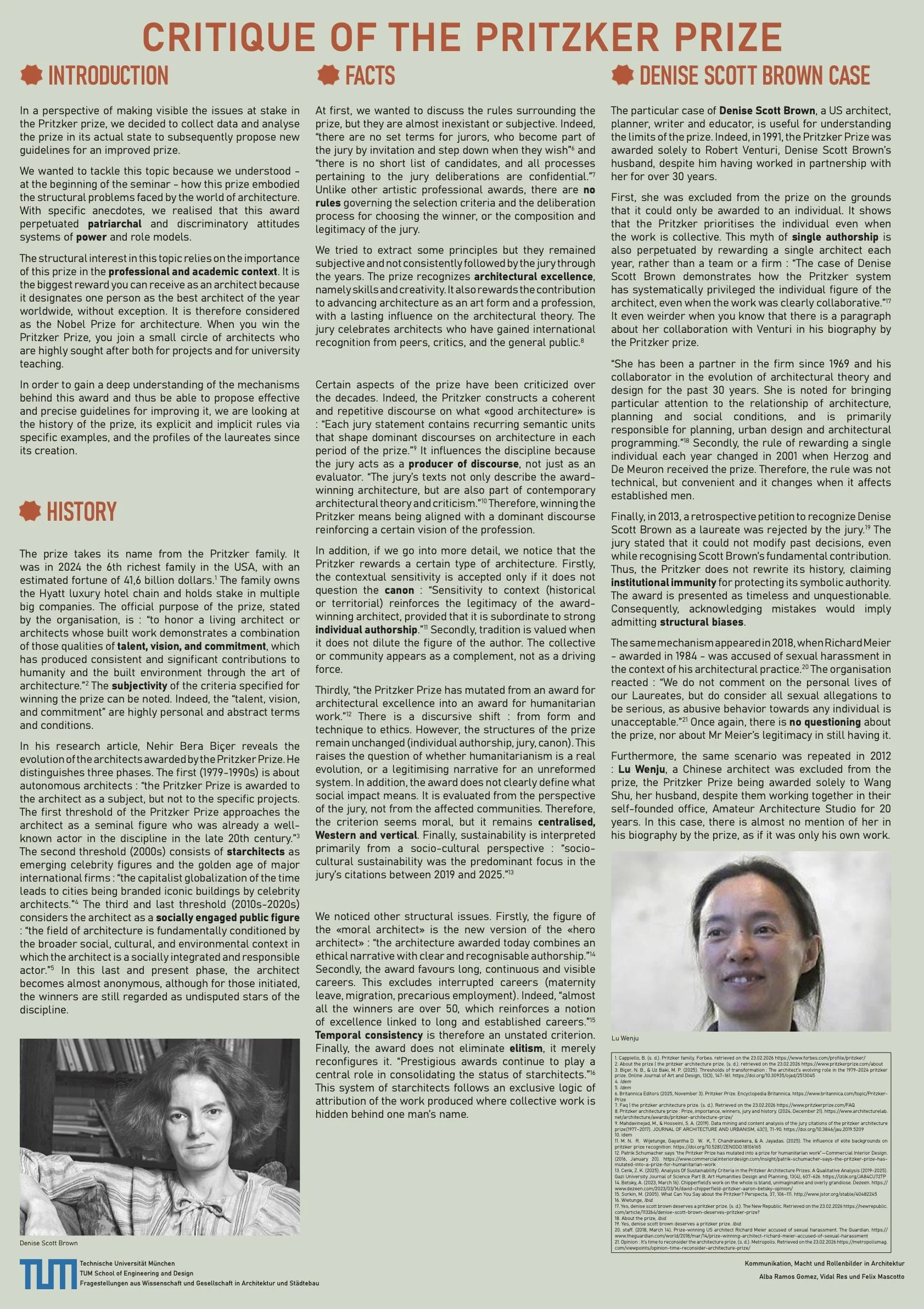
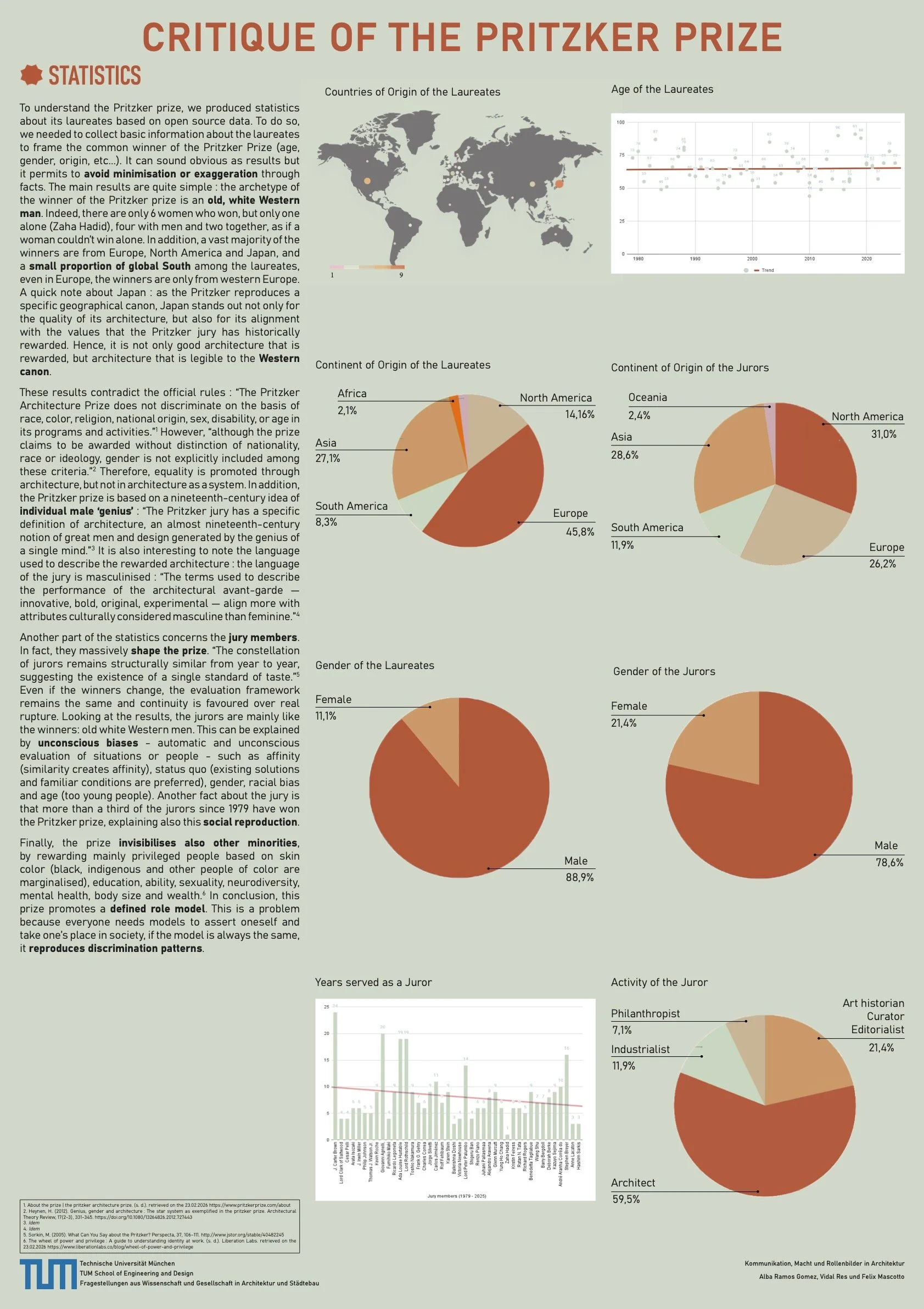
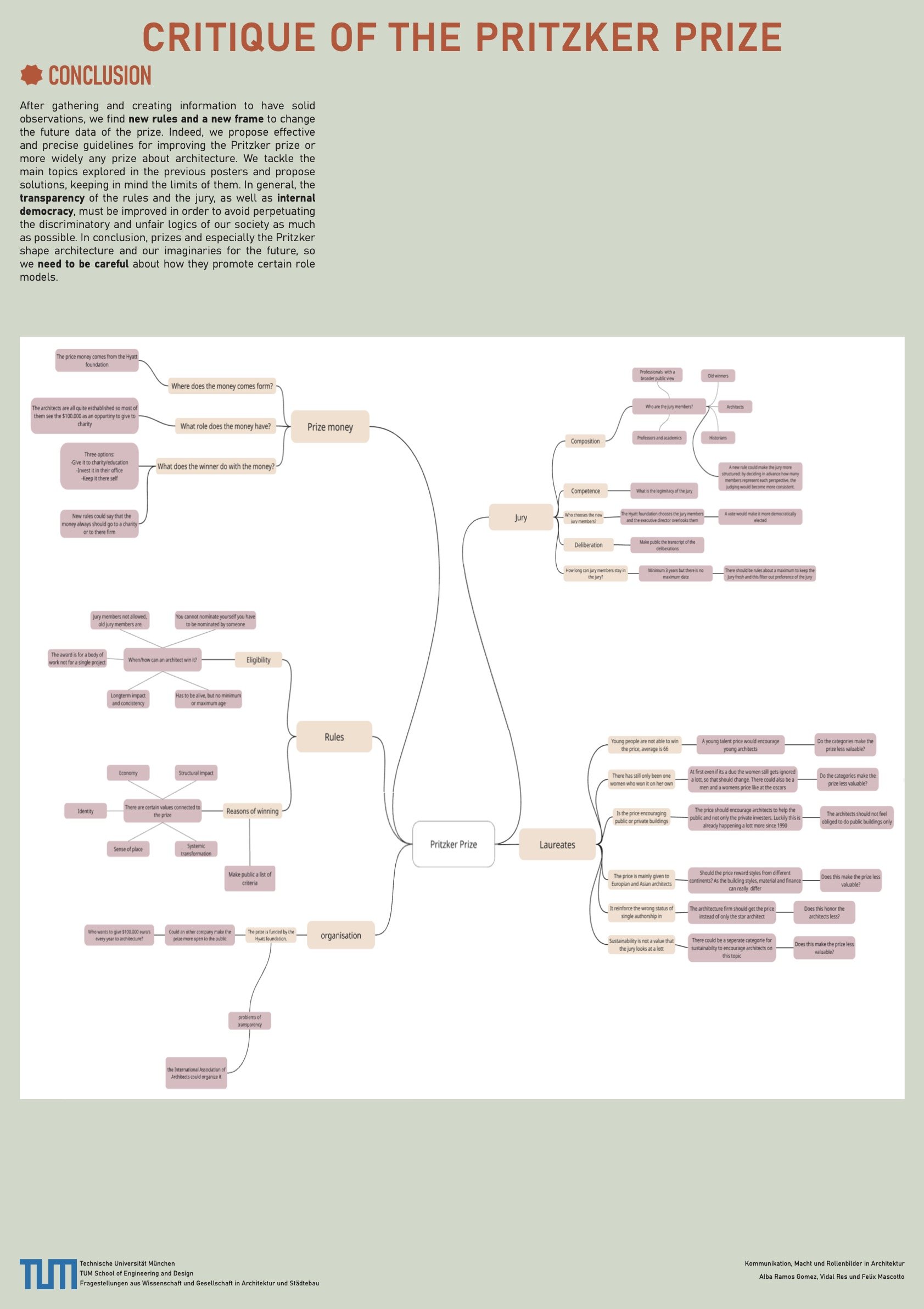
Die Seminararbeit macht bestehende Strukturen des Pritzker-Preises sichtbar und beginnt, Kriterien für eine faire Preisvergabe zu formulieren und zu hinterfragen. Dabei bleiben Fragen offen, dies steht jedoch in einem angemessenen Verhältnis zum Umfang eines Seminars mit 2 SWS.
Auf aktuelle Ereignisse und Berichterstattungen nimmt die Arbeit keinen Bezug. Nachdem Tom Pritzker Mitte Februar 2026 im Zusammenhang mit seiner Verbindung zu Jeffrey Epstein von seinen Funktionen bei der Hyatt Group zurücktrat, erhält die Diskussion zusätzliche Aktualität. Dieser Zusammenhang verdeutlicht den Bedarf nach einem neuen Preis mit transparentem und fairem Kriterienkatalog. Die Studierenden haben mit ihrer Arbeit die bisherigen Preisstrukturen sichtbar gemacht und erste Schritte in Richtung neuer Kriterien entwickelt. Offene Fragen stehen im Verhältnis zum Seminarumfang und schmälern weder die Leistung noch das Engagement der Beteiligten.
Sandra Cabrales
—
The seminar project makes existing structures of the Pritzker Prize visible and begins to formulate and question criteria for a fair award process. Some questions remain open, which is appropriate given the scope of a seminar with 2 SWS.
The project does not refer to current events or media coverage. After Tom Pritzker stepped down from his roles at the Hyatt Group in mid-February 2026 in connection with his ties to Jeffrey Epstein, the discussion has gained additional relevance. This context highlights the need for a new prize with a transparent and fair catalogue of criteria. Through their work, the students have made existing award structures visible and taken initial steps toward developing new criteria. The open questions are proportionate to the seminar’s scope and do not diminish the achievement or commitment of those involved.
Sandra Cabrales
Bauhaus Women
Students
Elle Böhm, Moritz Hemsal,
Victoria Rosina Stetter
date
23. February 2026
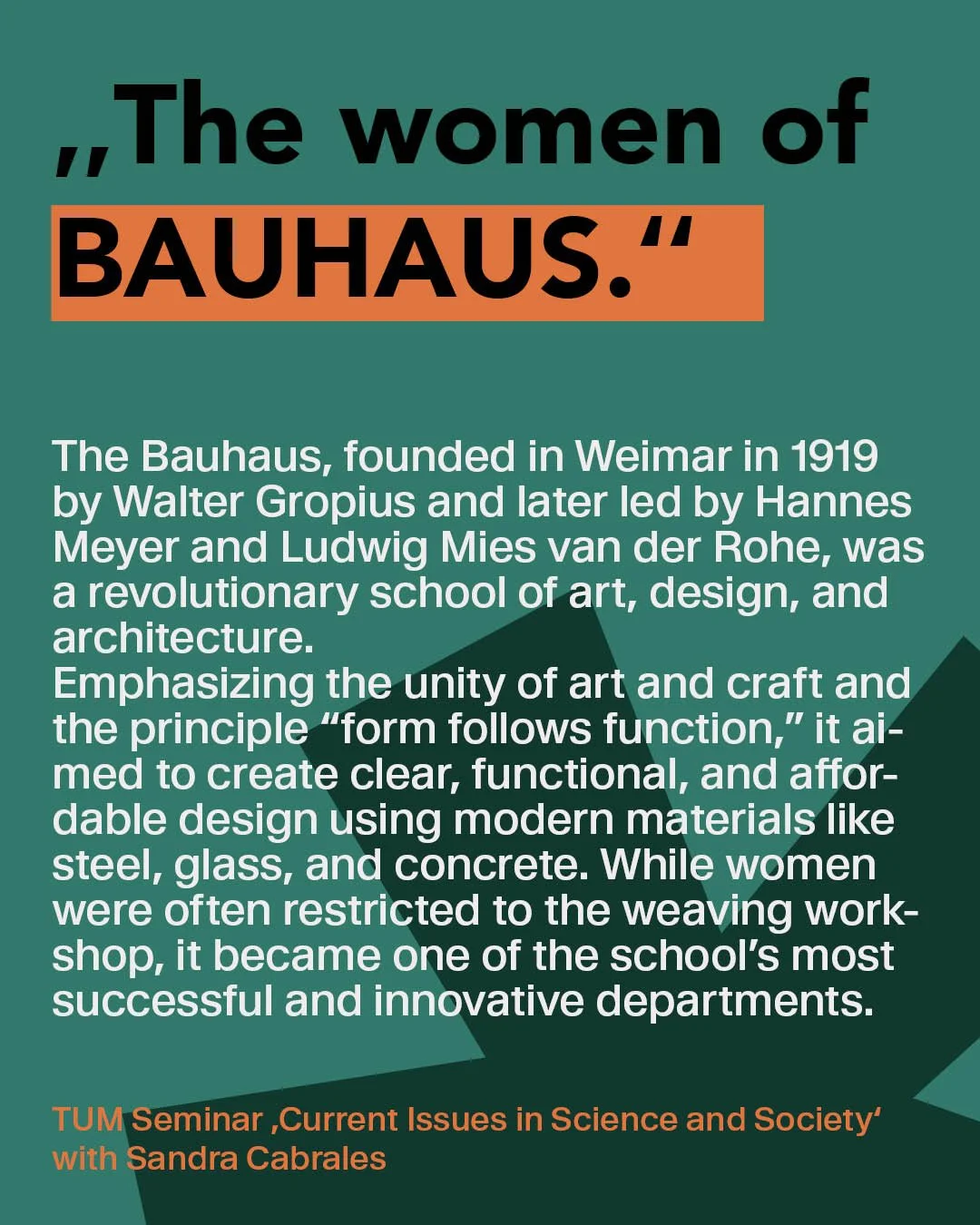
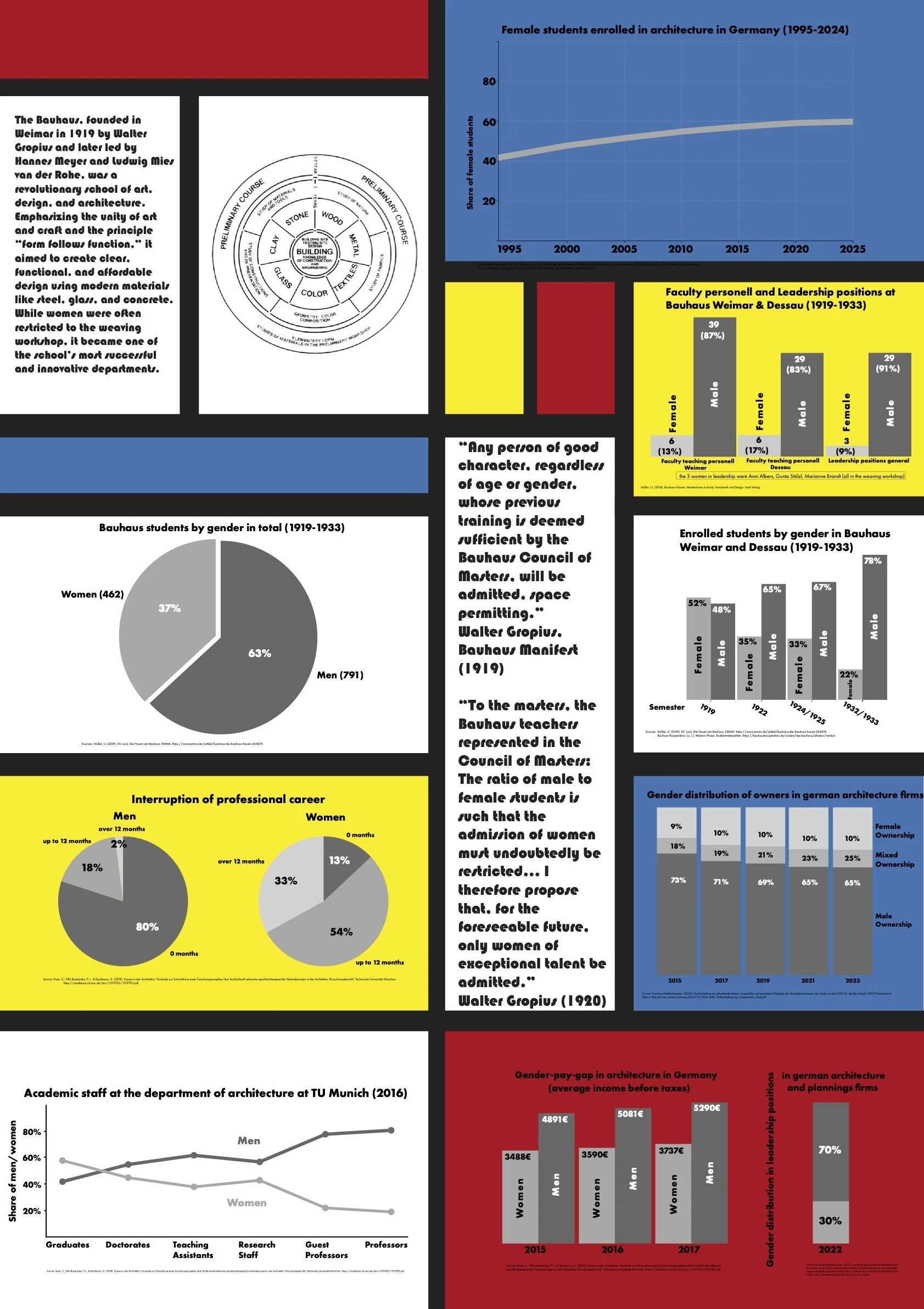
The Bauhaus opened in 1919 with a bold promise: admission regardless of gender. Yet within a year, director Walter Gropius called for strict restrictions on female enrollment, as women had outnumbered men in the very first semester — 84 to 79.
Women were systematically channelled into the weaving workshop, the so-called Frauenklasse, while other workshops remained largely closed to them. Of 32 workshop leadership positions across the entire Bauhaus period, only 3 were held by women — all in weaving. By 1932/33, the female share of students had fallen from 51% to just 22%.
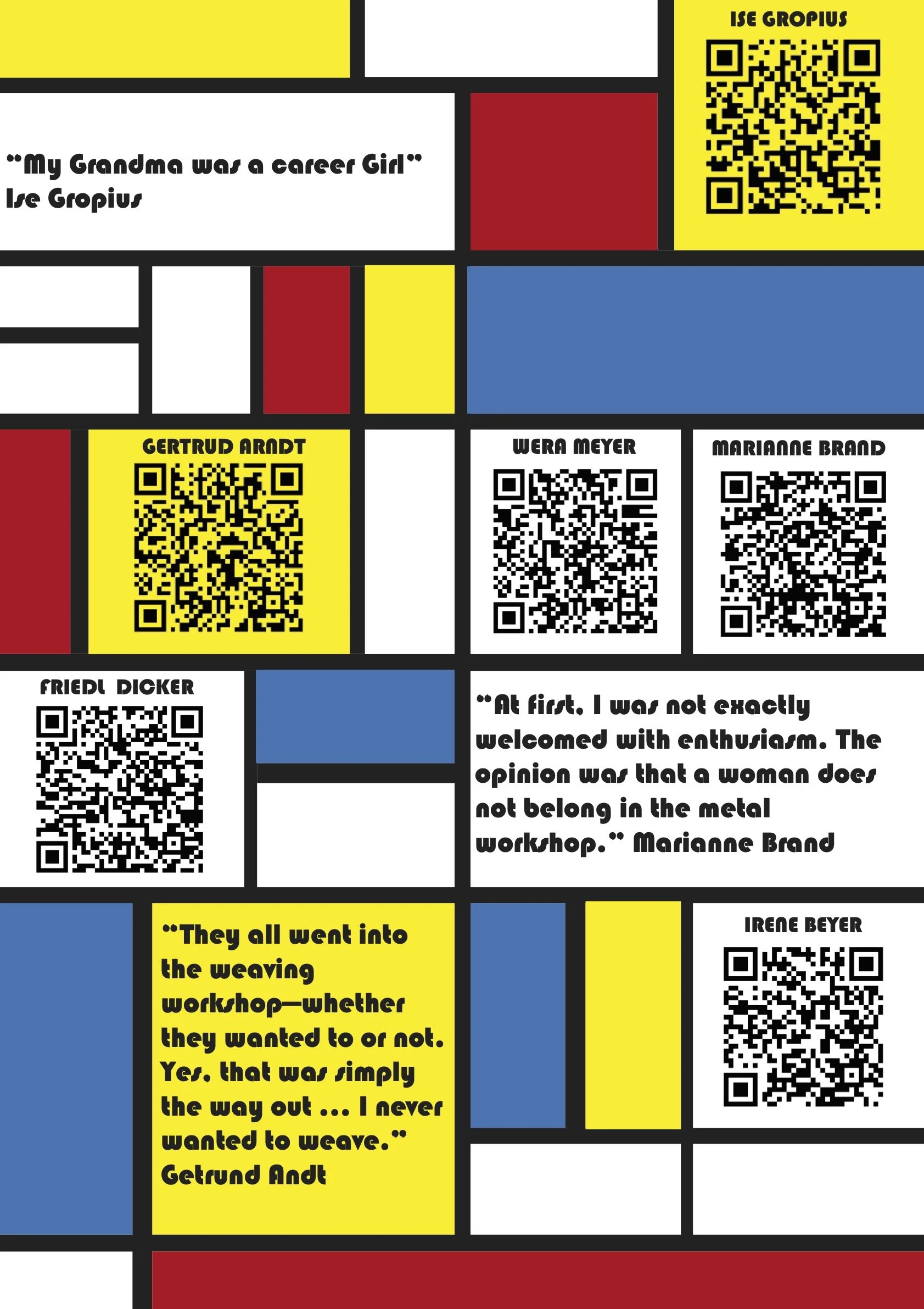
Yet those who persisted left lasting marks. Marianne Brandt became one of the Bauhaus's most celebrated designers, breaking into the male-dominated metal workshop. Gertrud Arndt, directed into weaving against her will, turned to photography and created some of the most striking portrait series of the era. Friedl Dicker developed a radical visual language across painting, textile, and stage design. Ilse Gropius, Wera Meyer, and Irene Beyer equally navigated a system that tolerated their presence while limiting their access.
The Bauhaus did not fail these women for lack of talent — it failed them by institutional design. A pattern that, as the data shows, has not fully disappeared: women today make up 60% of architecture students in Germany, yet hold only 30% of leadership positions in the profession.
As part of the seminar project, portraits of six women of the Bauhaus were created and published on a dedicated website.
Do you know her?
Students
Anna Adam, Aida Aherdan,
Emilio Braune, Nele Budnik,
Léontine Chenebaux
date
24. February 2026
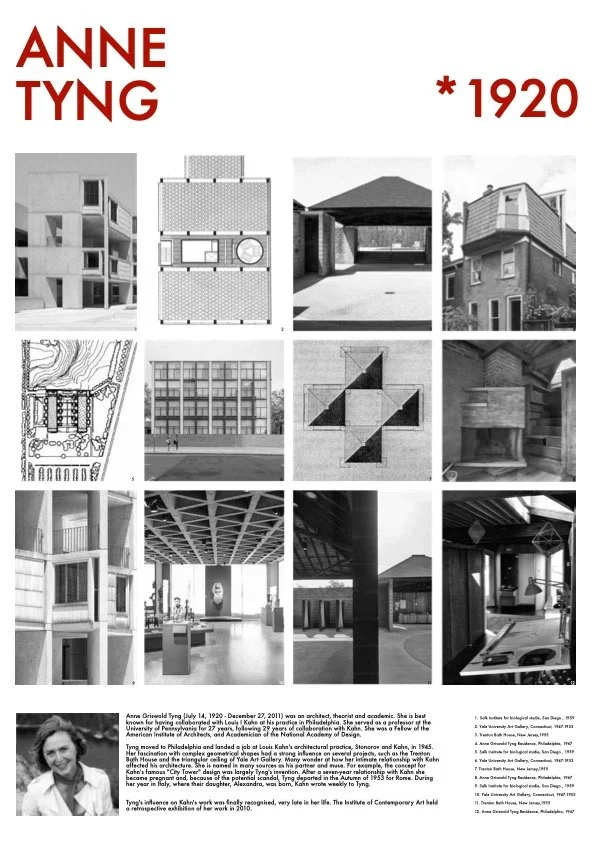
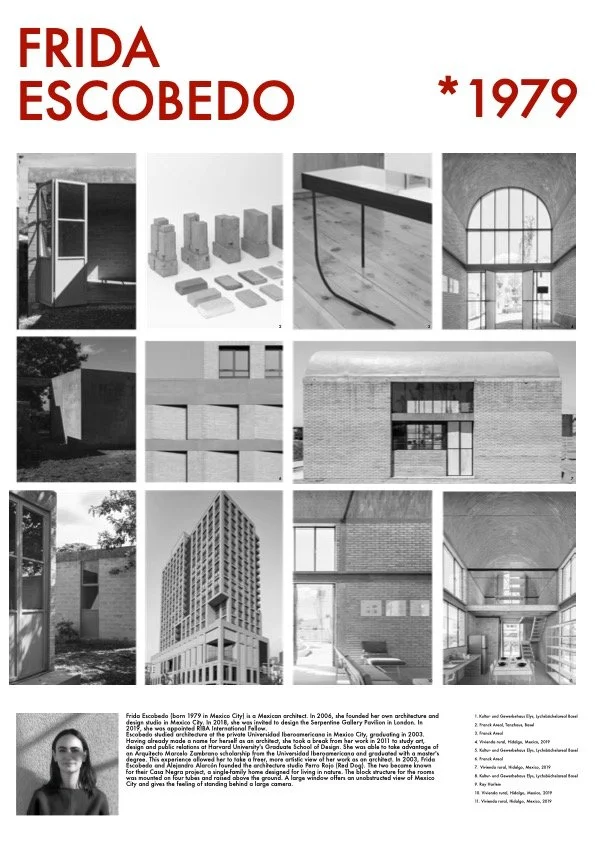
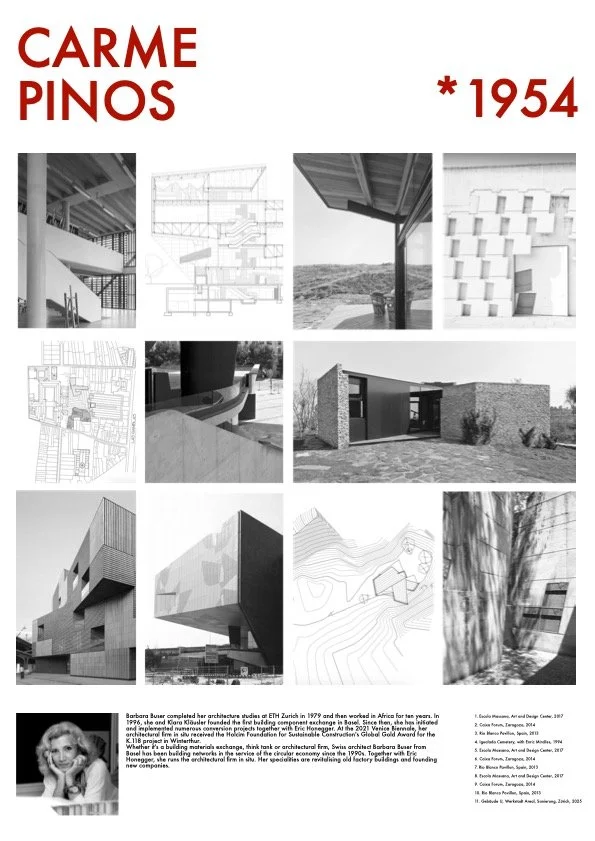
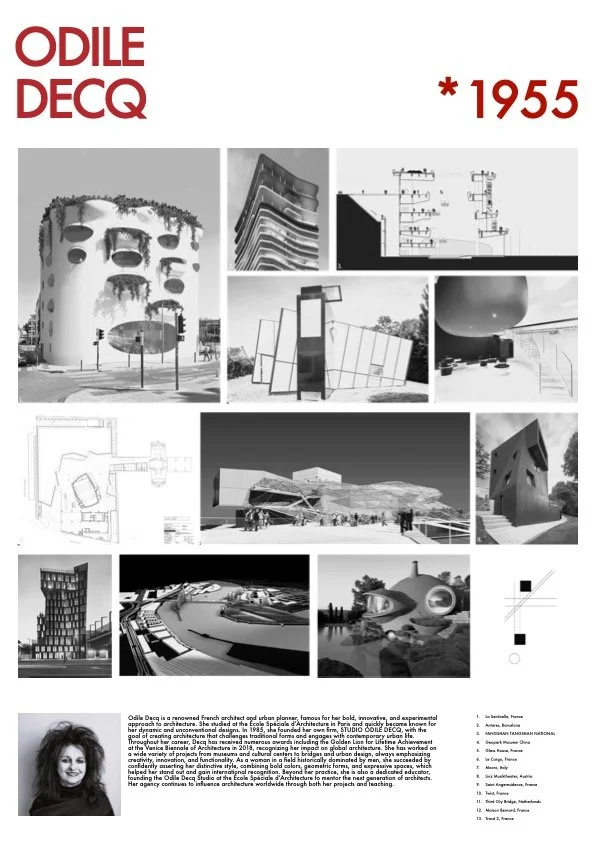
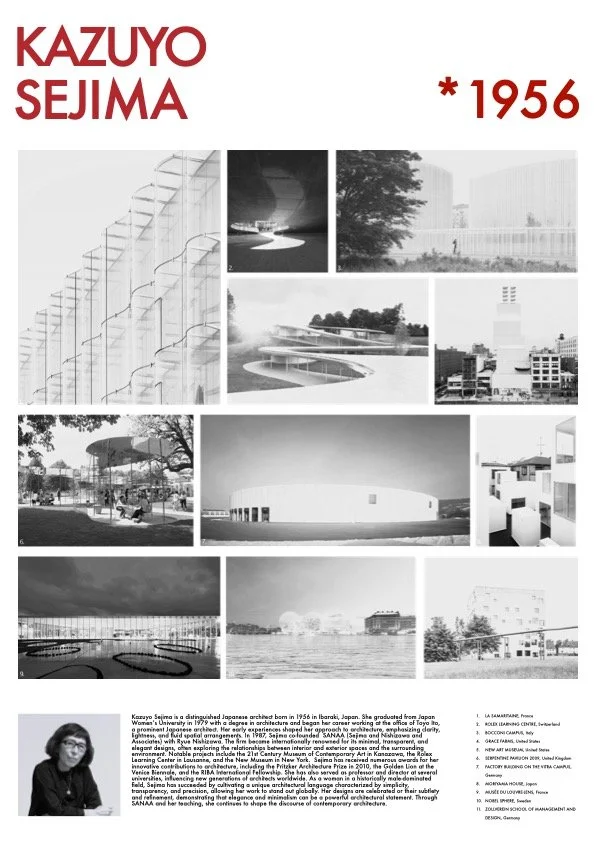
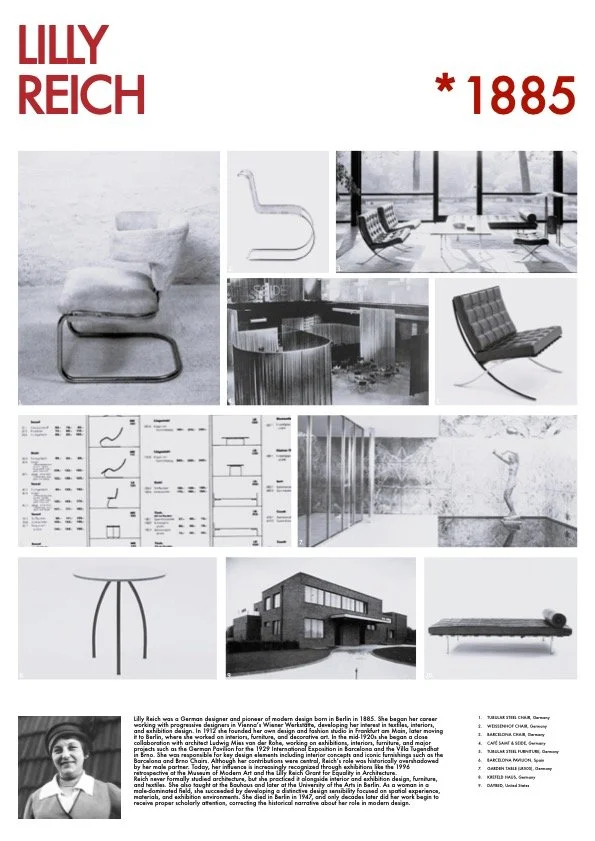
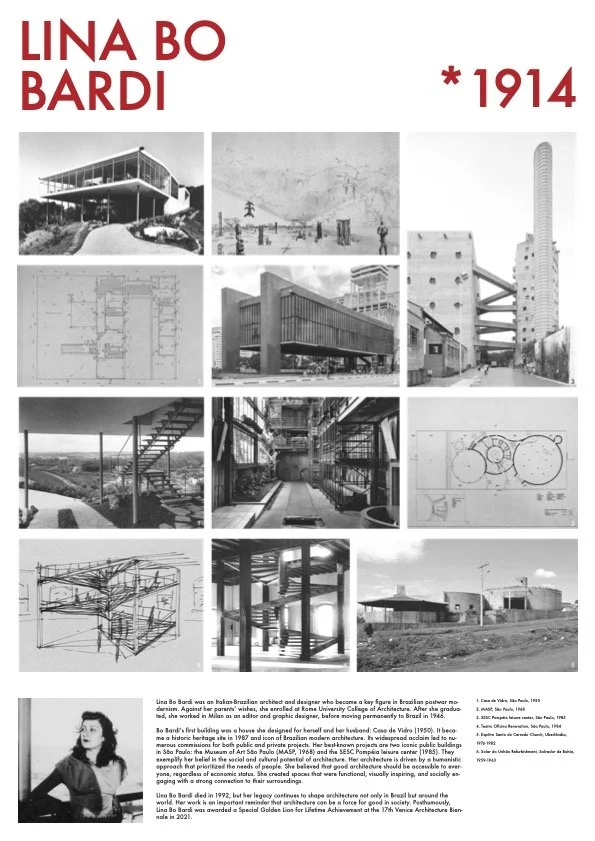
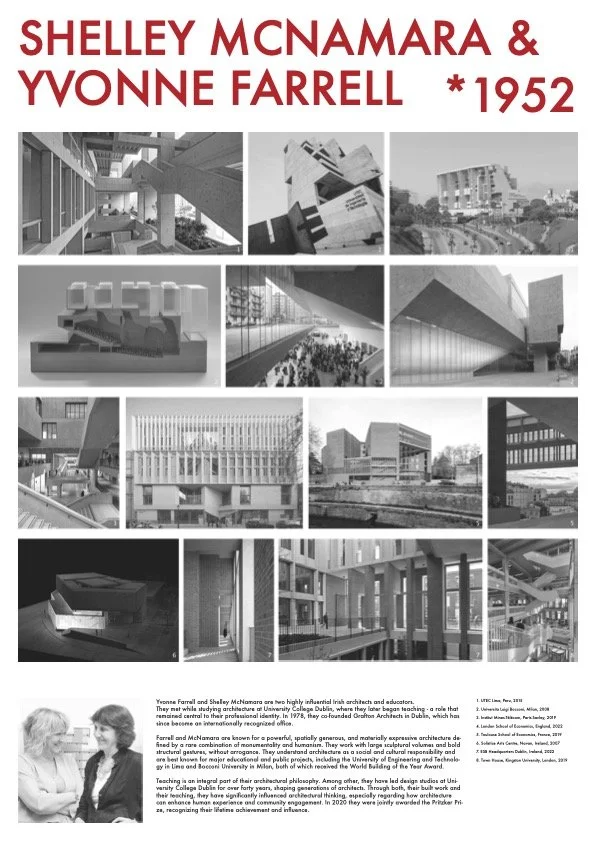
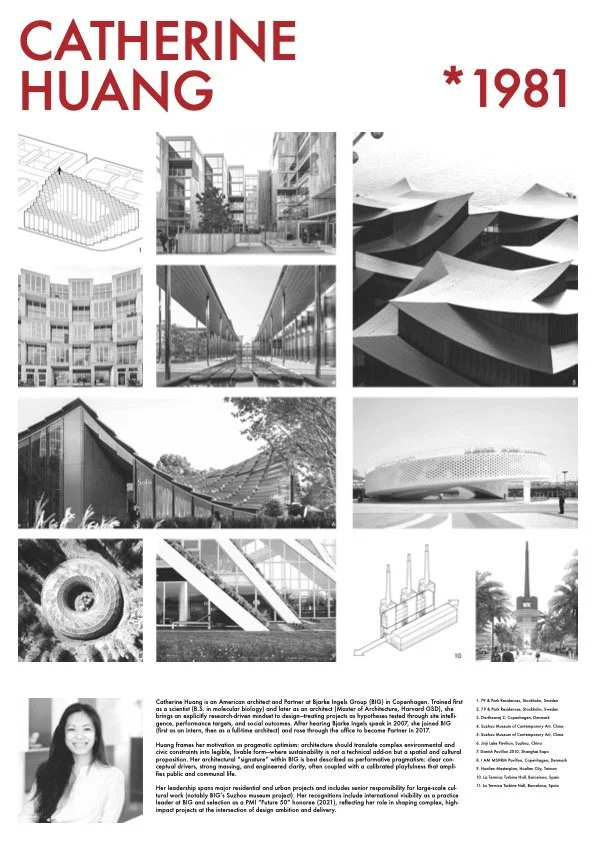
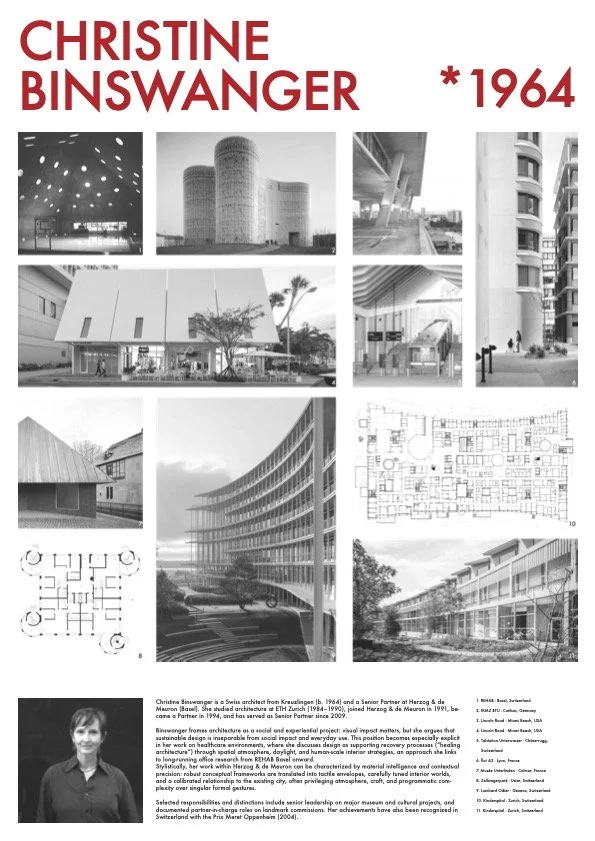
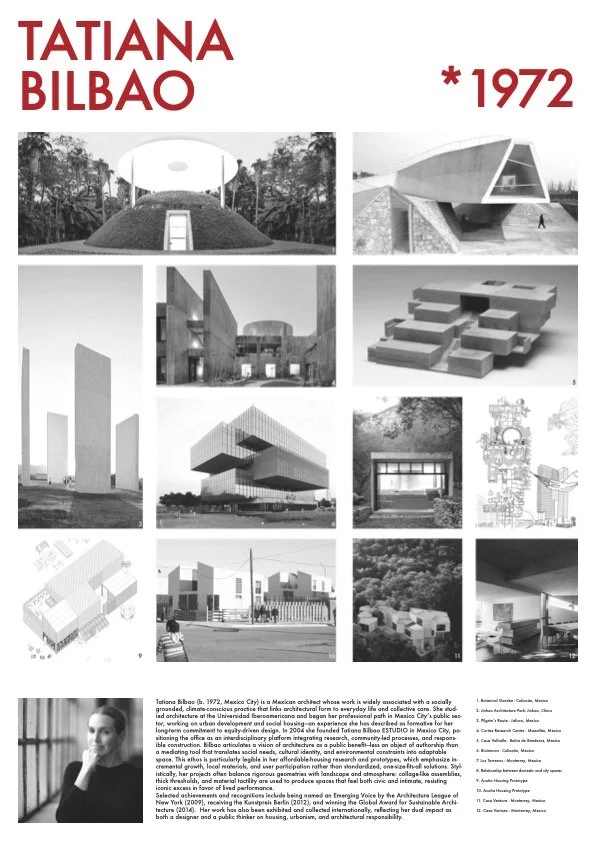
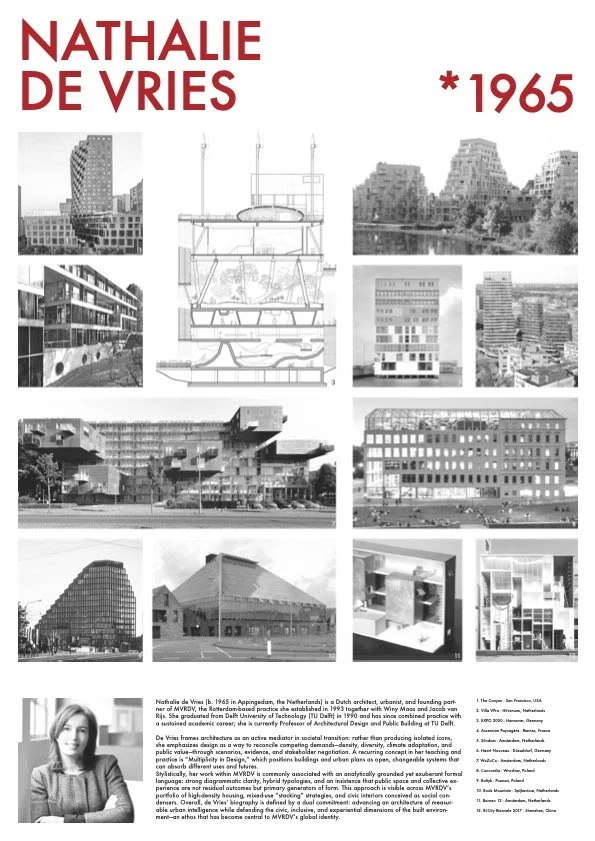
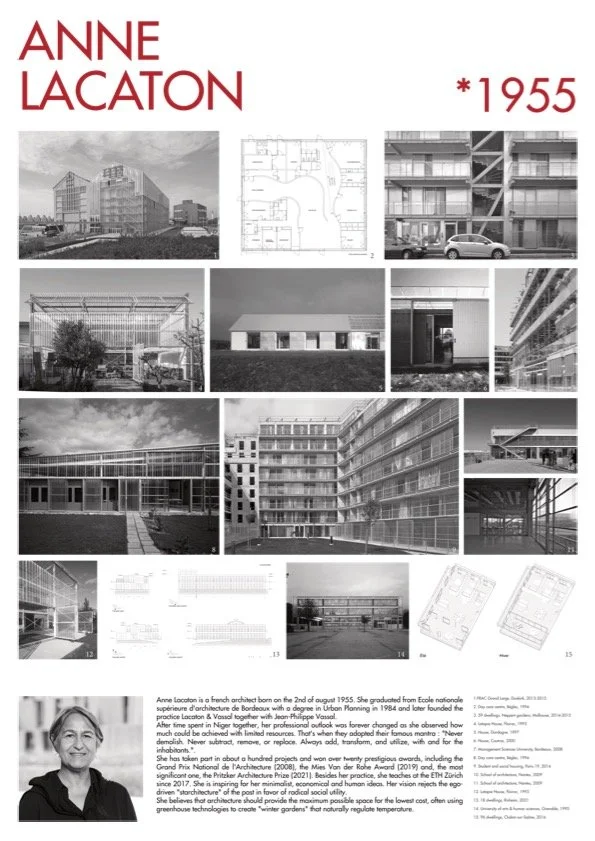
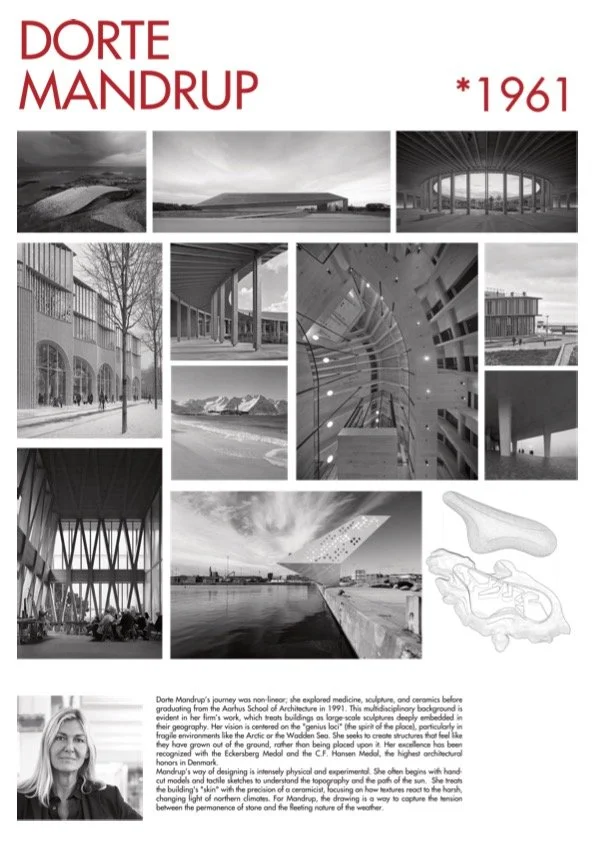
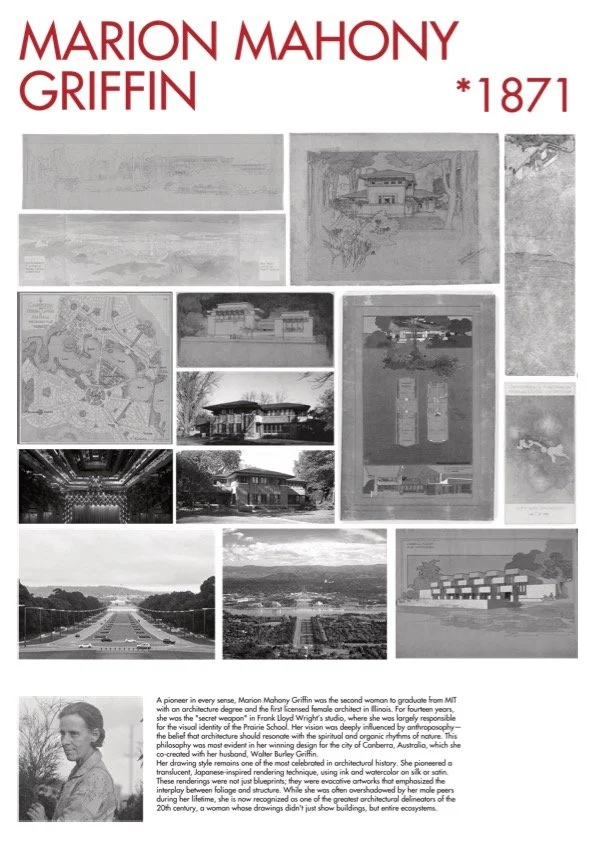
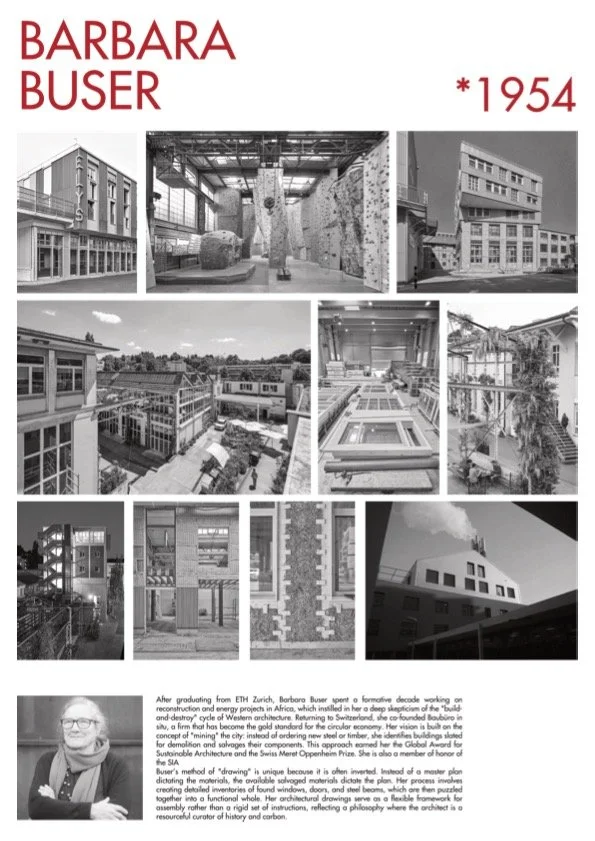
Both at universities and in architectural practices, there are almost as many men as women. Nevertheless, many people still find it difficult to name even five well-known female architects. This is sobering and does not do justice to the work of many women in the field of architecture.
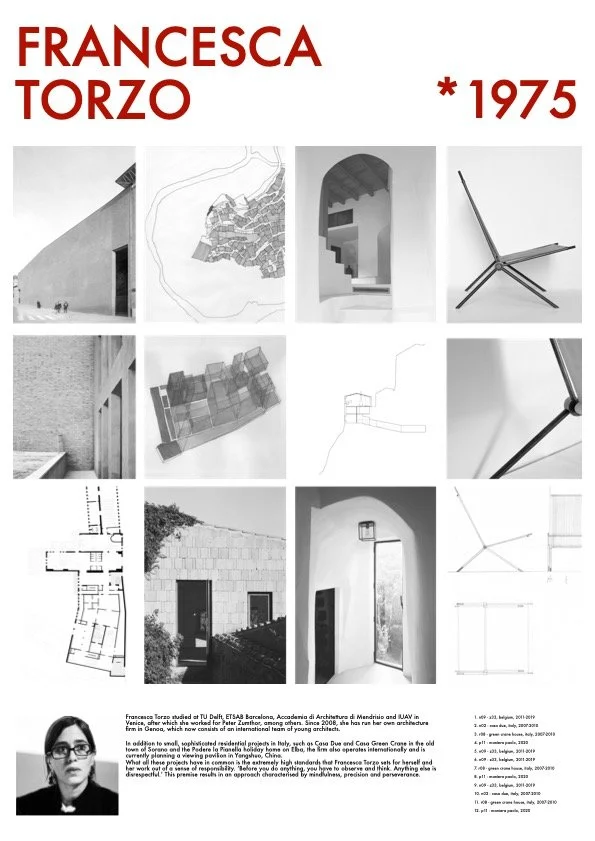
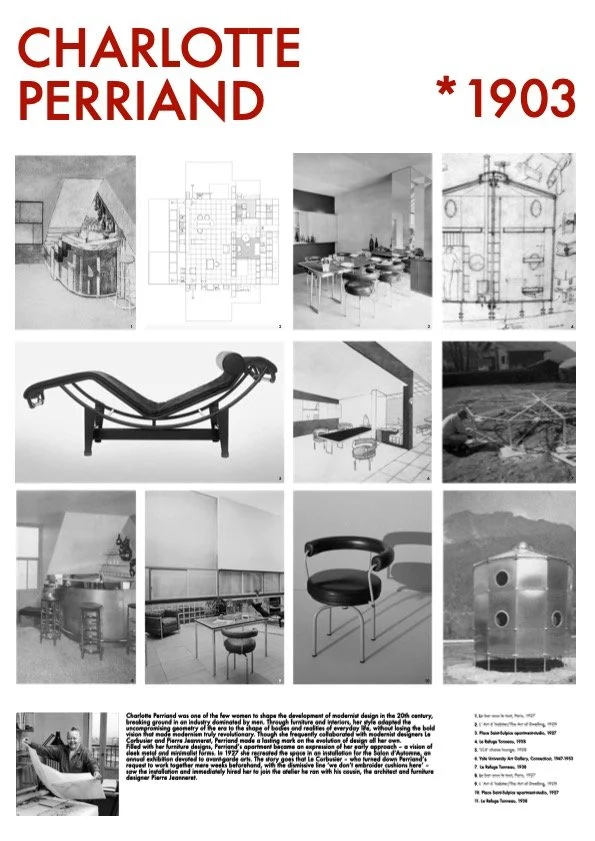
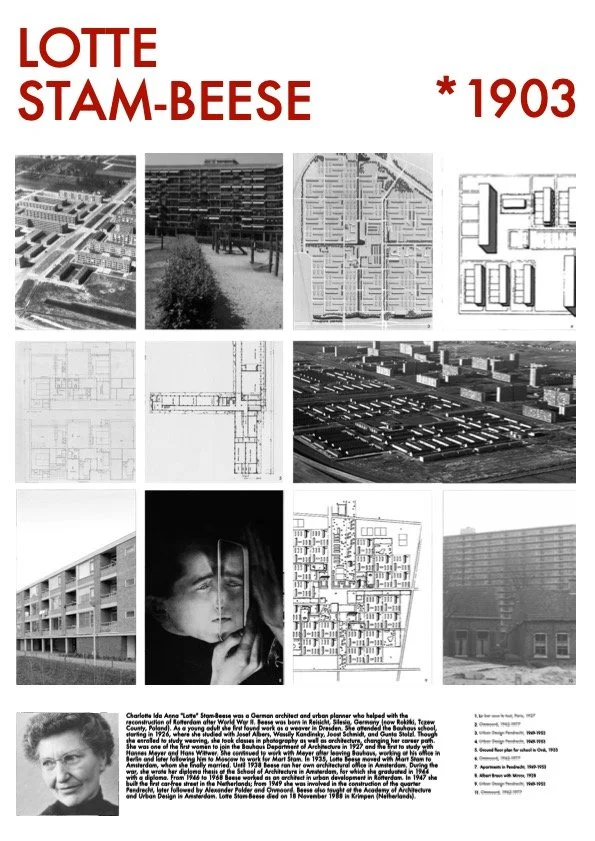
The seminar project was developed as the outcome of the seminar Communication, Power and Role Models in Architecture and is conceived as an exhibition titled “Do you know her?”. It aims to reach fellow students, challenge the current situation and foster a broader understanding of the impact of female architects.
On the one hand, it highlights women who, throughout the twentieth century, steered the course of major projects, often behind the scenes and in the shadow of their husbands. On the other, it features architects who, through their own practices, continue to achieve outstanding work today, as well as leading partners who oversee famous projects within internationally well-known offices.
Their work and professional trajectories will be brought to the fore, acknowledging and celebrating their contributions.
-
![Francesca Torzo]()
Francesca Torzo
-
![Charlotte Perriand]()
Charlotte Perriand
-
![Lotte Stam-Beese]()
Lotte Stam-Beese
-
![Anne Tyng]()
Anne Tyng
-
![Frida Escobedo]()
Frida Escobedo
-
![Carme Pinos]()
Carme Pinos
-
![Odile Decq]()
Odile Decq
-
![Mariam Kamara]()
Mariam Kamara
-
![Kazuyo Sejima]()
Kazuyo Sejima
-
![Lilly Reich]()
Lilly Reich
-
![Eileen Gray]()
Eileen Gray
-
![Lina Bo Bardi]()
Lina Bo Bardi
-
![Shelley McNamara & Yvonne Farrell]()
Shelley McNamara & Yvonne Farrell
-
![Catherine Huang]()
Catherine Huang
-
![Christine Binswanger]()
Christine Binswanger
-
![Tatiana Bilbao]()
Tatiana Bilbao
-
![Nathalie de Vries]()
Nathalie de Vries
-
![Anne Lacaton]()
Anne Lacaton
-
![Dorte Mandrup]()
Dorte Mandrup
-
![Marion Mahony Griffin]()
Marion Mahony Griffin
-
![Barbara Buser]()
Barbara Buser

Work in progress. The seminar content will be published here step by step.
This seminar is developed by Sandra Cabrales and carried out with the engagement of all participating students. Their perspectives, reflections and critical questions form the foundation of the collective learning process. IIf not stated otherwise, the written and visual documentation, including the integration of the process outcomes of their peers, was prepared by four students of the seminar group.
Students
Anna Lena Adam
Aida Aherdan
Brit Austermühl
Elle Böhm
Emilio Braune
Nele Sofie Budnik
Léontine Chenebaux
Marie Gebel
Moritz Hemsal
Felix Mascotto
Charlotte-Emilia Meinecke
Alba Ramos Gomez
Vidal Res
Louisa Schütz
Victoria Rosina Stetter
Editorial and Design
Brit Austermühl
Marie Gebel
Charlotte-Emilia Meinecke
Louisa Schütz
The seminar materials provided on this website do not claim to be complete. All information is supplied without guarantee. No liability is assumed for the accuracy, timeliness, or any consequences arising from the use of these materials.